Expositional commentary on Scripture using an inductive exegetical methodology intent upon confronting the lives of Christians with the dogmatic Truths of God's inspired Words opposing Calvinism and Arminianism, Biblical commentary, doctrine of grace enablement, understanding holiness and wisdom and selfishness, in-depth Bible studies, adult Bible Study books and Sunday School materials Dr. Lance T. Ketchum Line Upon Line

Monday, December 14, 2015

Dividing Darkness from the Light!


Dividing Darkness from the Light!
 

There are great spiritual truths found in the first five verses of the book of Genesis.  One of these great truths is that very early in God’s revelation of His will we find Him dividing between light and darkness.  Even though sin had not yet entered into God’s creation, God established a principle of separation – light is always divided from the darkness.  Darkness is the absence of light. 

“1 In the beginning God created the heaven and the earth. 2 And the earth was without form, and void; and darkness was upon the face of the deep. And the Spirit of God moved upon the face of the waters. 3 And God said, Let there be light: and there was light. 4 And God saw the light, that it was good: and God divided the light from the darkness. 5 And God called the light Day, and the darkness he called Night. And the evening and the morning were the first day” (Genesis 1:1-5).

Throughout the Bible, darkness portrays ignorance of God.  Secondly, darkness portrays the lives of those who are willfully ignorant of God and His will.  Those content to live in this dark ignorance of God will then often willfully walk without regard for God’s will.  Yet, God’s loving mercy continues to extend His offer of redemption and enlightenment to all generations. 

Light in the Bible portrays knowledge of God and His will.  Humanity’s fall into sin was accompanied by a loss of being able to know God apart from His revelation of Himself through His creation and through believers telling others of God’s will.  Moses is the first recorded individual to have been given the light of Word of God in written form.  The emphasis of the light of revelation in the written Word of God that is first revealed in the Bible account of creation is the omnipotence, omnipresence, and omniscience of God. 

Secondly, after the fall, the light of the revelation of God is the loving, longsuffering of God in the implementation of a plan of redemption that existed prior to Adam’s fall into sin and spiritual darkness (Revelation 13:8 and Genesis 3:15).  Adam became responsible for communicating God’s plan of redemption by grace through faith in the Promised One of Genesis 3:15 to his descendants. 

The darkness of willful rejection began to engulf humanity very early in Adam’s firstborn son named Cain.  The central point of the text is that Abel’s worship was pure in that he approached God solely on the basis of a substitute sacrifice.  Cain willfully rejected the purity of worship coming to God on the basis of human merit.  Abe’s worship is light.  Cain is absolute darkness manifesting itself in the premeditated murder of Abel.  Cain willfully rejected the light of redemption in the promised Substitute in Genesis 3:15.  Cain is the personification of what Jesus said in John 3:16-22 regarding condemnation and men loving darkness. 

“16 For God so loved the world, that he gave his only begotten Son, that whosoever believeth in him should not perish, but have everlasting life. 17 For God sent not his Son into the world to condemn the world; but that the world through him might be saved. 18 He that believeth on him is not condemned: but he that believeth not is condemned already, because he hath not believed in the name of the only begotten Son of God. 19 And this is the condemnation, that light is come into the world, and men loved darkness rather than light, because their deeds were evil. 20 For every one that doeth evil hateth the light, neither cometh to the light, lest his deeds should be reproved. 21 But he that doeth truth cometh to the light, that his deeds may be made manifest, that they are wrought in God” (John 3:16-21).

The longsuffering of God was certainly evident in the history of Israel as God patiently chastised them as they continually pursued the hedonistic and pornographic darkness of the lifestyles of the heathen nations around them.  In most cases, they chose darkness over light because they loved the darkness (typical of all worldliness; I John 2:15).  It is to this issue that Isaiah speaks in Isaiah 8:16-22

“16 Bind up the testimony, seal the law among my disciples. 17 And I will wait upon the LORD, that hideth his face from the house of Jacob, and I will look for him. 18 Behold, I and the children whom the LORD hath given me are for signs and for wonders in Israel from the LORD of hosts, which dwelleth in mount Zion. 19 And when they shall say unto you, Seek unto them that have familiar spirits, and unto wizards that peep, and that mutter: should not a people seek unto their God? for the living to the dead? 20 To the law and to the testimony: if they speak not according to this word, it is because there is no light in them. 21 And they shall pass through it, hardly bestead and hungry: and it shall come to pass, that when they shall be hungry, they shall fret themselves, and curse their king and their God, and look upward. 22 And they shall look unto the earth; and behold trouble and darkness, dimness of anguish; and they shall be driven to darkness” (Isaiah 8:16-22).

          Many people suffer under the false notion that somehow the world would be so much better if Jesus had not been crucified.  The death, burial, and resurrection of Christ necessary to a sinner’s redemption is the light of the Gospel of Jesus Christ that leads sinners out of the darkness of condemnation into the light of the eternal New Creation “in Christ Jesus.”  Perhaps that is why so many professing Christians are so enamored with the baby Jesus in the manger.  The manger scene is intended to depict the humility to which God was willing to stoop to become the Saviour of “whosoever will.”  He could never become our Saviour if He was not born sinless.  He could never become our Saviour if did not die vicariously for our sins.  The majority of the Old Testament prophecies regarding the birth of Messiah involve details of His death.  He was born to die on Calvary. 
         
Out of the darkness of God’s pending captivity judgment upon the backslidden nation of Israel comes the glorious light of God’s promise of the birth of Messiah.  Within this backslidden, chosen people of God there was a remnant of “disciples” (Isaiah 8:16).  The word “disciples” in Isaiah 8:16 is from the Hebrew word limmuwd (lim-mood’) referring to a group of people who were instructed in the things of God.  The purpose of discipleship is not to merely know the Bible.  The purpose of discipleship is to create living translations of God’s truth – “doers of the Word” (James 1:22).  To be merely a knower of the Word, or “hearers only,” is a form of self-deception. 

“1 Nevertheless the dimness shall not be such as was in her vexation, when at the first he lightly afflicted the land of Zebulun and the land of Naphtali {the area of Galilee around the sea of Galilee; the first area to be captured by Assyria and the first to hear the Gospel through Jesus}, and afterward did more grievously afflict her by the way of the sea, beyond Jordan, in Galilee of the nations. 2 The people that walked in darkness have seen a great light: they that dwell in the land of the shadow of death, upon them hath the light shined. 3 Thou hast multiplied the nation, and not increased the joy: they joy before thee according to the joy in harvest, and as men rejoice when they divide the spoil. 4 For thou hast broken the yoke of his burden, and the staff of his shoulder, the rod of his oppressor, as in the day of Midian. 5 For every battle of the warrior is with confused noise, and garments rolled in blood; but this shall be with burning and fuel of fire. 6 For unto us a child is born, unto us a son is given: and the government shall be upon his shoulder: and his name shall be called Wonderful, Counsellor, The mighty God, The everlasting Father, The Prince of Peace. 7 Of the increase of his government and peace there shall be no end, upon the throne of David, and upon his kingdom, to order it, and to establish it with judgment and with justice from henceforth even for ever. The zeal of the LORD of hosts will perform this” (Isaiah 9:1-7).

The Theological Workbook of the Old Testament (R. Laird Harris, Gleason L. Archer, Jr., and Bruce K. Waltke, Moody Press) says the word disciples “has the idea of training as well as educating.”  The idea is that through education (enlightenment), these people became servants of the Lord.  They would use their tongues to proclaim God’s Word regardless of what it might cost them personally.  Their ears were opened, ready to hear God’s message.  The promise of Messiah, as the ultimate suffering Servant, is always at the forefront of the mind of the “learned” or the “disciple.”  Isaiah 50:4-6 speaks specifically to Jesus as the Messiah.  Being His servant is proclaiming the message of salvation by grace through faith. 

“4 The Lord GOD hath given me {Jesus} the tongue of the learned, that I should know how to speak a word in season to him that is weary: he wakeneth morning by morning, he wakeneth mine ear to hear as the learned. 5 The Lord GOD hath opened mine ear, and I was not rebellious, neither turned away back. 6 I gave my back to the smiters, and my cheeks to them that plucked off the hair: I hid not my face from shame and spitting” (Isaiah 50:4-6).
         
Obviously, the “learned,” the true doers of the Word “disciples” of the Lord, were not ignorant of the fact that the “light” of the Messiah would come as a suffering servant.  There can be no true Christianity without servanthood.  Every person who truly understands the term Christian, first given to believers at Antioch, understands the depth of surrender and dedication to the mission of Christ that ensues from that term.  In John 11:8-10, Jesus spoke to the issue of fearing death and thereby avoiding the missional purpose of redemption

“8 His disciples say unto him, Master, the Jews of late sought to stone thee; and goest thou thither again? 9 Jesus answered, Are there not twelve hours in the day? If any man walk in the day, he stumbleth not, because he seeth the light of this world.  10 But if a man walk in the night, he stumbleth, because there is no light in him” (John 11:8-10).

Isaiah spoke of the suffering Servant more than any other prophet of God.  The “disciples” of the Lord who lived at the time of Isaiah were fully instructed regarding the coming of Messiah as the suffering Servant of Jehovah.  This is the model for all true believers – SERVANTHOOD. 

“1 Who hath believed our report? and to whom is the arm of the LORD revealed? 2 For he {the Messiah} shall grow up before him as a tender plant, and as a root out of a dry ground: he hath no form nor comeliness; and when we shall see him, there is no beauty that we should desire him. 3 He is despised and rejected of men; a man of sorrows, and acquainted with grief: and we hid as it were our faces from him; he was despised, and we esteemed him not. 4 Surely he hath borne our griefs, and carried our sorrows: yet we did esteem him stricken, smitten of God, and afflicted. 5 But he was wounded for our transgressions, he was bruised for our iniquities: the chastisement of our peace was upon him; and with his stripes we are healed. 6 All we like sheep have gone astray; we have turned every one to his own way; and the LORD hath laid on him the iniquity of us all. 7 He was oppressed, and he was afflicted, yet he opened not his mouth: he is brought as a lamb to the slaughter, and as a sheep before her shearers is dumb, so he openeth not his mouth. 8 He was taken from prison and from judgment: and who shall declare his generation? for he was cut off out of the land of the living: for the transgression of my people was he stricken. 9 And he made his grave with the wicked, and with the rich in his death; because he had done no violence, neither was any deceit in his mouth. 10 Yet it pleased the LORD to bruise him; he hath put him to grief: when thou shalt make his soul an offering for sin, he shall see his seed, he shall prolong his days, and the pleasure of the LORD shall prosper in his hand. 11 He shall see of the travail of his soul, and shall be satisfied: by his knowledge shall my righteous servant justify many; for he shall bear their iniquities. 12 Therefore will I divide him a portion with the great, and he shall divide the spoil with the strong; because he hath poured out his soul unto death: and he was numbered with the transgressors; and he bare the sin of many, and made intercession for the transgressors” (Isaiah 53:1-12).
         
Isaiah was not the first to reveal the suffering Servant of Jehovah.  David also wrote of Him in Psalm 22 two-hundred years earlier.

“1 My God, my God, why hast thou forsaken me? why art thou so far from helping me, and from the words of my roaring? 2 O my God, I cry in the daytime, but thou hearest not; and in the night season, and am not silent. 3 But thou art holy, O thou that inhabitest the praises of Israel. 4 Our fathers trusted in thee: they trusted, and thou didst deliver them. 5 They cried unto thee, and were delivered: they trusted in thee, and were not confounded. 6 But I am a worm, and no man; a reproach of men, and despised of the people. 7 All they that see me laugh me to scorn: they shoot out the lip, they shake the head, saying, 8 He trusted on the LORD that he would deliver him: let him deliver him, seeing he delighted in him. 9 But thou art he that took me out of the womb: thou didst make me hope when I was upon my mother’s breasts. 10 I was cast upon thee from the womb: thou art my God from my mother’s belly. 11 Be not far from me; for trouble is near; for there is none to help. 12 Many bulls have compassed me: strong bulls of Bashan have beset me round. 13 They gaped upon me with their mouths, as a ravening and a roaring lion. 14 I am poured out like water, and all my bones are out of joint: my heart is like wax; it is melted in the midst of my bowels. 15 My strength is dried up like a potsherd; and my tongue cleaveth to my jaws; and thou hast brought me into the dust of death. 16 For dogs have compassed me: the assembly of the wicked have inclosed me: they pierced my hands and my feet. 17 I may tell all my bones: they look and stare upon me. 18 They part my garments among them, and cast lots upon my vesture” (Psalm 22:1-18).

The prophetic message of the suffering Servant of Jehovah looks forward in time to the first advent of Messiah in Jesus Christ.  Both the first and second advents of Jesus Christ happen in times of history when the people of God are living in the greatest darkness.  The darkness in the world is not due to the wickedness of the world, but the wickedness, apathy, and carelessness of professing believers. 
         
In the first advent, the Cross of Jesus Christ was a place where this darkness was the most evident.  Jesus came to those people who had been looking for His coming for thousands of years and they rejected Him and murdered Him. 

“11 He came unto his own, and his own received him not. 12 But as many as received him, to them gave he power to become the sons of God, even to them that believe on his name: 13 Which were born, not of blood, nor of the will of the flesh, nor of the will of man, but of God. 14 And the Word was made flesh, and dwelt among us, (and we beheld his glory, the glory as of the only begotten of the Father,) full of grace and truth” (John 1:11-14).

Jesus came to these people who had almost memorized the Law of God, but yet the darkness still overwhelmed their souls because the truths of God’s Word never got beyond their dead externalism to bring light and life into them.  Out of the darkness that encompassed the Crucifixion, we hear the thundering voice of Jesus probably using the last few ounces of strength left in His body:

“45 Now from the sixth hour there was darkness over all the land unto the ninth hour. 46 And about the ninth hour Jesus cried with a loud voice, saying, Eli, Eli, lama sabachthani? that is to say, My God, my God, why hast thou forsaken me” (Matthew 27:45-46)?

We wonder at these words.  Why would Jesus ask such a question as this?  Surely He must have known why God had forsaken Him?  Oh friends, this question is not for Him.  It was a reminder to Israel of David’s words in Psalm 22.  It was a reminder to Israel of the holiness of God for that was the Psalmist’s answer to the question in Psalm 22.

“1 My God, my God, why hast thou forsaken me? why art thou so far from helping me, and from the words of my roaring? 2 O my God, I cry in the daytime, but thou hearest not; and in the night season, and am not silent. 3 But thou art holy, O thou that inhabitest the praises of Israel” (Psalm 22:1-3).

Why does God not hear the cries and pleas of the forsaken?  He does not hear because God is holy and because the forsaken are the forsaken because of sin, because of apathy, because of worldliness, and because of carelessness.  The world is in darkness because all these things exist in the lives of professing believers.  God has already heard and answered the plea of the forsaken. 

“1 God, who at sundry times and in divers manners spake in time past unto the fathers by the prophets, 2 Hath in these last days spoken unto us by his Son, whom he hath appointed heir of all things, by whom also he made the worlds; 3 Who being the brightness of his glory, and the express image of his person, and upholding all things by the word of his power, when he had by himself purged our sins, sat down on the right hand of the Majesty on high” (Hebrews 1:1-3).

“27 What I tell you in darkness, that speak ye in light: and what ye hear in the ear, that preach ye upon the housetops. 28 And fear not them which kill the body, but are not able to kill the soul: but rather fear him which is able to destroy both soul and body in hell” (Matthew 10:27-28).

The Cross of Jesus Christ was both a place of utter, stifling darkness and glorious, blinding light.  For those lost in the darkness of sin and ignorance, the darkness must have been overwhelming.  To the “disciples” of Jesus who understood the many Scripture references to the suffering Servant of Jehovah, the light of that truth must have shown so brightly that they could do nothing more but to stand in awe as they looked upon their dying Saviour. 

“2 The people that walked in darkness have seen a great light: they that dwell in the land of the shadow of death, upon them hath the light shined . . .6 For unto us a child is born, unto us a son is given: and the government shall be upon his shoulder: and his name shall be called Wonderful, Counsellor, The mighty God, The everlasting Father, The Prince of Peace” (Isaiah 9:2 & 6). 

Like the remnant of Israel at Christ’s first advent, we may be a people who walk in the darkness of a God hating, truth rejecting world, but we do not have to be a part of that darkness.  We can be contributors to the light rather than contributors to the darkness if we will cast off our apathy, worldliness, and carelessness and give our lives to be servants of YAHWEH.

“In him was life; and the life was the light of men” (John 1:4).

“Then spake Jesus again unto them, saying, I am the light of the world: he that followeth me shall not walk in darkness, but shall have the light of life” (John 8:12).

If your life is filled with the darkness of despair and hopelessness, perhaps your need is “the life” that is “light of men.”  You can have that “life” by simple faith in Jesus Christ.  Turn away from your worldly pursuits and selfish motives in life.  Come to the Light.  It is shining in the darkness for you to find your way home. 

The Light of the world is Jesus!

Anonymous comments will not be allowed. 
Numerous studies and series are available free of charge for local churches at: http://www.disciplemakerministries.org/ 
Dr. Lance Ketchum serves the Lord as a Church Planter, Evangelist/Revivalist. 
He has served the Lord for over 40 years.

Tuesday, December 8, 2015

Fruitless Lives

 Fruitless Lives
 

When John the Baptist saw the unrepentant Pharisees come to his baptism of repentance (Matthew 3:2), he said unto them “O generation of vipers, who hath warned you to flee from the wrath to come” (Matthew 3:7)?  Then John the Baptist said to them, “Bring forth therefore fruits meet for repentance” (Matthew 3:8).  In other words, by the authority of God in the prophet, John the Baptist expected an amended lifestyle and amended beliefs BEFORE he would baptize anyone.  Genuine repentance always manifests itself with an amended lifestyle that corresponds with the will of God and an amended belief system that corresponds with salvation by grace alone through faith alone in Christ alone!
         
Perhaps there is no greater anomaly to the Christian life than a fruitless believer professing to have been “born again of the Spirit of God.  Such an anomaly is a contradiction of the greatest proportion.  Jesus speaks of this anomaly in Matthew 7:15-29 in no uncertain terms.  Jesus equates fruitless professors as “wolves” who are “in sheep’s clothing.”  These “wolves” come to the Church looking like sheep, talking like sheep, but then Jesus says “ye shall know them by their fruits.”  The main point of the New Creation is recreating “wolves” into “sheep.”  “Wolves” come to church services with a completely different feeding agenda than do the “sheep.”  “Wolves” are takers.  Sheep are givers.  It is readily apparent how easily true “sheep” can be taken advantage of by “wolves.”
         
There was a whole industry of Rabbis and Rabbinical schools at the time of Christ.  Young men were sent to these various schools to be trained in the Mosaic Law and the interpretation of Rabbinical schools of thought.  Almost every educated Jew was trained in one of these Bible Schools.  However, once these people professed faith in Christ, they simply added the teachings of Jesus to what they had already been previously taught.  Most of that previous teaching was legalistic both in regard to the issue of salvation and practical sanctification.  Many of these men did not repent of these false beliefs regarding salvation and sanctification.  They simply began to integrate these false teachings in with true Christianity.  These are the “wolves” to whom Jesus refers in Matthew 7:15.
         
The local churches involved in Contemporary Christian music and making church service appear as little like church services as possible are filling their churches with empty people.  They have compromised the Gospel message to the place where repentance is never mentioned.  People can come to Christ while trusting in their own self-righteousness (meaning they do not think themselves so bad that God would send them to Hell).  They come to Jesus with no knowledge of what the death, burial, and resurrection of Jesus accomplishes on their behalf.  They have no more than a superficial knowledge of the Lordship of Jesus and what that entails for them as they “confess with thy mouth the Lord Jesus” (Romans 10:9).
         
There is no preaching repentance of sin and “dead works” in these churches pastored by “wolves” in sheep’s clothing.  These “wolves” are nothing more than the devil’s carnival show hucksters trying to fleece the sheep for all they have.  They are so busy gathering crowds they give no thought, nor do they care, that Jesus will not show up.  He will not show up because they do not gather in His Name, which is holy and separate from the very things they so tenaciously promote.

“15 Beware of false prophets, which come to you in sheep’s clothing, but inwardly they are ravening wolves. 16 Ye shall know them by their fruits. Do men gather grapes of thorns, or figs of thistles? 17 Even so every good tree bringeth forth good fruit; but a corrupt tree bringeth forth evil fruit. 18 A good tree cannot bring forth evil fruit, neither can a corrupt tree bring forth good fruit. 19 Every tree that bringeth not forth good fruit is hewn down, and cast into the fire. 20 Wherefore by their fruits ye shall know them. 21 Not every one that saith unto me, Lord, Lord, shall enter into the kingdom of heaven; but he that doeth the will of my Father which is in heaven. 22 Many will say to me in that day, Lord, Lord, have we not prophesied in thy name? and in thy name have cast out devils? and in thy name done many wonderful works? 23 And then will I profess unto them, I never knew you: depart from me, ye that work iniquity. 24 Therefore whosoever heareth these sayings of mine, and doeth them, I will liken him unto a wise man, which built his house upon a rock: 25 And the rain descended, and the floods came, and the winds blew, and beat upon that house; and it fell not: for it was founded upon a rock. 26 And every one that heareth these sayings of mine, and doeth them not, shall be likened unto a foolish man, which built his house upon the sand: 27 And the rain descended, and the floods came, and the winds blew, and beat upon that house; and it fell: and great was the fall of it. 28 And it came to pass, when Jesus had ended these sayings, the people were astonished at his doctrine: 29 For he taught them as one having authority, and not as the scribes” (Matthew 7:15-29).

There are two major problems that dominate most local churches:

1. Members who have walked the isle, prayed the prayer, been dunked in the tank, but who have never repented of sin and been converted in their hearts
2. Members who have never been taught that the Christian-life is supernaturally produced and is available ONLY to the fully surrendered, Spirit-filled believer seeking to live totally separated from worldliness and unto God

It is critically important that we understand the audience to whom Jesus is speaking in Matthew 7:15.  We must go back to Matthew 5:1-2 to see this.  “1 And seeing the multitudes, he went up into a mountain: and when he was set, his disciples came unto him: 2 And he opened his mouth, and taught them, saying . . .”  Therefore, why was it essential that the Apostles and true disciples of Jesus understand the warning of Matthew 7:15-29?  Every believer must understand that the greatest enemies of the Church and the mission of Christianity are often found inside the Church.  These “wolves” are people who have a false agenda.   The agenda of these people is about what the “sheep” offer them.  These “wolves” have in “inward” contradiction that testifies against real conversion and Christianity.

According to the context of Matthew 7:15-29, these “wolves” propagate lifestyles that disconnect the believer from knowing doctrine and living according to the things Jesus had just taught in Matthew chapters five and six.  However, the context asserts a much more complex reality to the false teaching of these “wolves” that enter into the flock (local church).  The false teaching creates false professions and false Christian lives.  The failure to properly teach repentance in salvation creates professing Christians who will come before Christ at the judgment expecting rewards for their “good works” when in fact they are not converted.  It is to these people that Jesus addresses the test, “by their fruits ye shall know them” (Matthew 7:20).

These hypothetical false converts come to Jesus at the judgment testifying of miraculous deeds and having “done many wonderful works” (Matthew 7:22).  However, according to the context of Matthew 7:15-29, the most basic of the evidences of genuine conversion is absent – personal obedience to live the teachings of Jesus in Matthew chapters five through seven.  “Therefore whosoever heareth these sayings of mine, and doeth them” (Matthew 7:24). 

We must be extremely clear here.  It is not that doing the things that Jesus teaches in Matthew chapters five through seven will saved anyone.  The point of the word “fruit” is that doing the things that Jesus teaches in Matthew chapters five through seven will be the outcome (“fruit”) of a genuine conversion and progressive transformation of the “born again” believer’s life.  If the person’s salvation is genuinely rooted in repentance of sin and “dead works,” then the “fruit” of that root will be living the teachings of Jesus (doctrine).  The purpose of right doctrine is to change the way we think, feel, and live.  Therefore, the foundation of right doctrine is repentance of all false doctrine; wrong thinking, wrong feelings, and wrong living.  The truly converted person is consumed with knowing right doctrine so as to abandon all falsehood in thinking, feeling, and living.  This is the context of Paul’s warning regarding the “wolves” of the last days of the Church Age in II Timothy chapter three.

“1 This know also, that in the last days perilous times shall come. 2 For men shall be lovers of their own selves, covetous, boasters, proud, blasphemers, disobedient to parents, unthankful, unholy, 3 Without natural affection, trucebreakers, false accusers, incontinent, fierce, despisers of those that are good, 4 Traitors, heady, highminded, lovers of pleasures more than lovers of God; 5 Having a form of godliness, but denying the power thereof: from such turn away. 6 For of this sort are they which creep into houses, and lead captive silly women laden with sins, led away with divers lusts, 7 Ever learning, and never able to come to the knowledge of the truth. 8 Now as Jannes and Jambres withstood Moses, so do these also resist the truth: men of corrupt minds, reprobate concerning the faith. 9 But they shall proceed no further: for their folly shall be manifest unto all men, as theirs also was” (II Timothy 3:1-9).

Historical records tell us that Jannes and Jambres were the two princes of the Pharaoh’s magicians mimicking the miracles that God performed through Moses.  The main import of these two imposters is that they were hindrances to Pharaoh seeing that Moses was the messenger from Jehovah and that Pharaoh should listen to Moses.  The comparison to the “wolves” of false teachers of which Paul warns is that these false teachers “also resist the truth: men of corrupt minds, reprobate concerning the faith” (II Timothy 3:8).  False teachers are dangerous.  False teachers produced false conversions and false disciples.  What is Paul’s solution to false teachers, false doctrine, false conversions, and false lifestyles?  Paul’s solution is right doctrine beginning with belief in verbal, plenary inspiration.  Right doctrine exposes false teachers and corrects false conversions.  Right doctrine biblically defines genuine conversions, practical sanctification, and sacrificial lifestyles.

“16 All scripture is given by inspiration of God, and is profitable for doctrine {learning the will of God}, for reproof {to convince men of the will of God}, for correction {to straighten men out when they stray from the will of God}, for instruction in righteousness (training in moral ethics and principles of moral equity; i.e. justice}: 17 That the man of God may be perfect, throughly furnished unto all good works” (II Timothy 3:16-17).

The subtlety of the teaching of “wolves” is very dangerous because this teaching sounds so good and oozes the honey of false love.  The false teacher comes teaching unity without establishing any doctrinal perimeters for this unity.  Anytime you have someone purporting unity at the sacrifice of doctrinal purity or practical holiness, you are listening to a false teacher – a wolf.  Anytime you have someone minimizing doctrine to maximize unity, you are listening to a false teacher – a wolf.


This is to what Jesus refers when He says theses wolves “come to you in sheep’s clothing” (Matthew 7:15).  These wolves dress like sheep and take on the innocence of sheep, “but inwardly they are ravening wolves” (Matthew 7:15).  The word “ravening” is from the Greek word harpax (har’-pax).  This means these people are motivated by greed and will try to achieve their goals by distortion and extortion.  These people are actually predatory in their nature.  These are theological contortionists and chameleons.  They become whatever they need to become in order to gather a following.  This is so subtle.

The true preacher/teacher wants NO ONE to live by the preacher’s values.  The true preacher/teacher wants every person to discover the teachings of Jesus, own those teachings for himself, and live those teachings from the heart.  There are very few men who can be trusted with a large body of believers without being corrupted by the nature of compromise that sees maintaining the size of that large body of believers as more important than maintaining the doctrinal soundness of that body.  In this context, wolves are often revealed more by what they deemphasize rather than by what they emphasize.

There is a very small minority of people, who call themselves Christians, who really want to live for the Lord and obey His commandments from the heart.  The corruption of the doctrine of grace (the supernatural empowering through the filling of the Spirit) has left the majority of Christianity powerless over their own corrupt natures.

In Matthew 7:12, Jesus gives us a universal principle for all dealing with the pathological (abnormal) way we treat other people.  Treat others the way you want to be treated.  Do for others what you might want them to do for you if you were in a similar situation.  This is the universal principle of equitable justice (doing what is right in the eyes of God).  We do not require an 8,000-page document defining every situation of life and what God’s will might be regarding a moral response to that situation.  This is not rocket science.  This is merely the very basic, but universal principle of moral ethics in human relationships.

We also see in Matthew 7:12 that Jesus says that this universal principle of being equitable “is the law and the prophets.”  In other words, this is the summary responsibility of all moral obligations defined by the long list of issues given in the book of Leviticus.  One of God’s consistent accusations against the corrupt priesthood of Israel and the children of Israel was their great propensity for perverting “justice and judgment” against one another.  How important are the matters of “justice and judgment” to God?

“1 The proverbs of Solomon the son of David, king of Israel; 2 To know wisdom and instruction; to perceive the words of understanding; 3 To receive the instruction of wisdom, justice, and judgment, and equity; 4 To give subtilty to the simple, to the young man knowledge and discretion” (Proverbs 1:1-4).

“2 Every way of a man is right in his own eyes: but the LORD pondereth the hearts. 3 To do justice and judgment is more acceptable to the LORD than sacrifice” (Proverbs 21:2-3).

Here we must interject the Pathology (study of abnormalities) of mankind’s fall and the spiritual corruption of our desires and wills that necessitates giving the Golden Rule.  God’s Golden Rule is His attempt for us to restore ourselves back to a normal, functional existence within a society of others. 

Medically, Pathology is simply the study of disease and the physical changes that disease causes.  There are also such things as Spiritual Pathology and Social Pathology.  Spiritual Pathology is the study of the corruption of the human nature and how that corruption affects an individual in his deviation away from God’s intended norm.

Biblical instruction seeks to restore the norm; therefore, the Golden Rule.  Social Pathology is the study of how spiritual corruption affects a society, such as a local church, community, or a nation abnormally.  The teaching of God’s Word is intended to correct both of these abnormalities (Pathologies).

A Spiritual pathology resulted in a Social Pathology in Israel.  The corruption of “justice and judgment” in Israel evolved to where the rich were advantaged and the poor were disadvantaged.  Although God had established the year of Jubilee (every fifty years) so that certain families in Israel could not acquire all the real estate, the perversion of “justice and judgment” allowed the Jubilee to often go by with little affect.  Kings became Monarchs and the people their subjects as indentured servants.  Perverted priests perverted “justice and judgment” through graft and bribes of money or political posturing.  God spoke to Israel through the prophet Isaiah saying:

“1 Behold, the LORD’S hand is not shortened, that it cannot save; neither his ear heavy, that it cannot hear: 2 But your iniquities have separated between you and your God, and your sins have hid his face from you, that he will not hear. 3 For your hands are defiled with blood, and your fingers with iniquity; your lips have spoken lies, your tongue hath muttered perverseness. 4 None calleth for justice, nor any pleadeth for truth: they trust in vanity, and speak lies; they conceive mischief, and bring forth iniquity. 5 They hatch cockatrice’ eggs, and weave the spider’s web: he that eateth of their eggs dieth, and that which is crushed breaketh out into a viper. 6 Their webs shall not become garments, neither shall they cover themselves with their works: their works are works of iniquity, and the act of violence is in their hands. 7 Their feet run to evil, and they make haste to shed innocent blood: their thoughts are thoughts of iniquity; wasting and destruction are in their paths. 8 The way of peace they know not; and there is no judgment {justice} in their goings: they have made them crooked paths: whosoever goeth therein shall not know peace. . . 12 For our transgressions are multiplied before thee, and our sins testify against us: for our transgressions are with us; and as for our iniquities, we know them; 13 In transgressing and lying against the LORD, and departing away from our God, speaking oppression and revolt, conceiving and uttering from the heart words of falsehood. 14 And judgment {justice or moral equity} is turned away backward, and justice standeth afar off: for truth is fallen in the street, and equity cannot enter. 15 Yea, truth faileth; and he that departeth from evil maketh himself a prey: and the LORD saw it, and it displeased him that there was no judgment {justice or moral equity}” (Isaiah 59:1-8 and 12-15).

Christ’s statement in Matthew 7:12 corresponds with His statement regarding hungering and thirsting after righteousness in Matthew 5:6 and His statement “seek ye first the kingdom of God, and his righteousness” in Matthew 6:33.  Righteousness is equity in “justice and judgment.”  The first place to “hunger and thirst” for equity in “justice and judgment” is in our own lives and in the way we make restitution for our failings with other people.  In seeking to restore or resolve, we begin by asking ourselves the simple question – if someone did to me what I did to them, how would I want that person to respond to me? 

This principle of equity goes far beyond mere material restitution for damages.  There are some damages for which no amount of money can ever make restitution.  The principle of equity takes numerous factors into consideration.

1. What pain have I caused?
2. What trust have I broken?
3. What are the long term ramifications of my offense?
4. What damage exists of which I might not even be aware?
5. Can the damage I caused by this offense be repaired?

The person who lives the principle of equity looks far beyond mere resolution or restitution.  The person who lives the principle of equity puts himself into (empathy) the hurt, pain, anxiety, and suffering his carelessness has caused. 

This is what is referred as pathos.  Pathos is a Greek word that simply refers to the arousal of genuine emotions or feelings.  Those feelings can be sympathy, sorrow, remorse, pity, tenderness, mercy, and etc.

The Sociopath has no pathos.  He feels no empathy for the person he uses or hurts.  The Sociopath has no sympathy for those he has harmed.  He may manufacture a pathos in order to manipulate a situation and to restore himself in the eyes of others, but these emotions are really plastic.  When it gets down to the nitty-gritty of personal sacrifices necessary to restore trust and rebuild a relationship, he will bail out as soon as things become too demanding for him.

Matthew 7:12 is often referred to as the Golden Rule.  This is the all-encompassing moral principle from which all true ethics spring forth.  This is the moral compass that always points to God-kind righteousness.  It is basic enough that any simpleton can understand it and simple enough so that no one has any excuse for failure.  Obedience to the Golden Rule begins with putting the thoughts and feelings of the person offended, hurt, or harmed before one’s own pride or self-protection.

The application of the Golden Rule cannot be born without humility and its intent cannot be sustained without genuine moral character.  James refers to this as the Royal Law (James 2:8).  The Royal Law is to love God above ourselves and to love others as we love ourselves. 

The Royal Law is the essence and summary of the original Tables of Stone Commandments recorded in Exodus 20:1-17 from Mt. Sinai.  The first four commandments refer to loving God above ourselves.  The last six commandments refer to loving our neighbor as ourselves.  Therefore, we cannot love God or our neighbors if we live contrary to these commandments.  The first four commandments are summarized in the Old Testament Shema recorded in Deuteronomy 6:4-5.  Both categorizes of love in these Table of Stone Commandments are summarized and restated in Matthew 22:37-40.  It is certainly significant that God chose to write these Table of Stone Commandments in stone as a permanent record and reminder to all generations. 

“4 Hear, O Israel: The LORD our God is one LORD: 5 And thou shalt love the LORD thy God with all thine heart, and with all thy soul, and with all thy might” (Deuteronomy 6:4-5).

“37 Jesus said unto him, Thou shalt love the Lord thy God with all thy heart, and with all thy soul, and with all thy mind. 38 This is the first and great commandment. 39 And the second is like unto it, Thou shalt love thy neighbour as thyself. 40 On these two commandments hang all the law and the prophets” (Matthew 22:37-40).

Matthew 7:12-14 give us the summary application of the intent of the Table of Stone Commandments.  God’s commandments are not intended to be mere guiding principles for life or suggestions for successful living.  They are imperatives from God that are to be practically applied and manifestly lived.  Failure in the essence of the application of the Table of Stone Commandments, and living them practically, manifests both an unloving disregard for the Person of God and Sociopathy towards our fellowman.

In Matthew chapters five through seven, Christ defines God’s expectations of the Table of Stone Commandments in an in-depth expectation that none, but perhaps a few, Old Covenant believers could have ever grasped.  With Christ’s explanation in the details of Matthew chapter five through seven, there is no such excuse available for New Covenant believers.  We can never say, we did not know or we did not understand.

Matthew 7:13-14 is referring to the “walk” of the Christian life.  It is not referring to salvation of our souls, but to entering into a narrow way of life and the saving of our lives from ruin and waste.  The substance of text follows from the context of the previous two chapters in giving instruction to believers regarding their practical sanctification.  With that context in mind, read the text again.  “13 Enter ye in at the strait gate: for wide is the gate, and broad is the way, that leadeth to destruction, and many there be which go in thereat: 14 Because strait is the gate, and narrow is the way, which leadeth unto life, and few there be that find it.” 

In Luke 13:24, Jesus uses the “strait gate” as an entrance into eternal life.  In that text, the “strait gate” is used in the context of the salvation of the soul.  However, the context of Matthew chapters five through seven does not allow for that application of the” strait gate.”  In Luke 13:24, Jesus uses the “strait gate” to refer to Himself and His finished work of redemption in His death, burial, and resurrection. 

“23 Then said one unto him, Lord, are there few that be saved? And he said unto them, 24 Strive to enter in at the strait gate: for many, I say unto you, will seek to enter in, and shall not be able {because they seek entrance through Moralism or Ritualism}. 25 When once the master of the house {Messiah Jesus} is risen up {referring to His resurrection}, and hath shut to the door, and ye begin to stand without {outside of the Kingdom of God because of refusing to repent of sin and ‘dead works’}, and to knock at the door {God does not hear the knocking of those who are already dead, no second chances}, saying, Lord, Lord, open unto us; and he shall answer and say unto you, I know you not whence ye are {they were already in Hell, the ‘I know you not’ is used in the familial sense in that they were not ‘born again’} : 26 Then shall ye begin to say, We have eaten and drunk in thy presence, and thou hast taught in our streets. 27 But he shall say, I tell you, I know you not whence ye are; depart from me, all ye workers of iniquity. 28 There shall be weeping and gnashing of teeth, when ye shall see Abraham, and Isaac, and Jacob, and all the prophets, in the kingdom of God {the eternal New Heaven/Earth}, and you yourselves thrust out {this is the Great White Throne Judgment at the end of time}. 29 And they shall come from the east, and from the west, and from the north, and from the south, and shall sit down in the kingdom of God. 30 And, behold, there are last {Gentiles} which shall be first, and there are first {Jews} which shall be last” (Luke 13:23-30).

However, although Matthew 7:13-14 has a different context, the text is in harmony with Luke 13:23-34 in the sense of the warning in Luke 13:23-34 corresponding with the warning of Matthew 7:21-29.  The warning is that the possession of eternal life ought to manifest itself in a new walk and new priorities of life that correspond with a Kingdom of God view of existence; Kingdom Living.  The idea is that genuine salvation is more than entrance into a new position of existence.  Genuine salvation SHOULD manifest itself in the fruit of a new practice of a new existence.  The genuinely “born again” child of God should begin living as a citizen of the Kingdom of God by living separated from worldliness and separated unto God’s eternal purposes.

“21 Not every one that saith unto me, Lord, Lord, shall enter into the kingdom of heaven (this is the physical, Millennial Kingdom}; but he that doeth the will of my Father which is in heaven. 22 Many will say to me in that day, Lord, Lord, have we not prophesied in thy name? and in thy name have cast out devils? and in thy name done many wonderful works? 23 And then will I profess unto them, I never knew you: depart from me, ye that work iniquity. 24 Therefore whosoever heareth these sayings of mine, and doeth them, I will liken him unto a wise man, which built his house upon a rock: 25 And the rain descended, and the floods came, and the winds blew, and beat upon that house; and it fell not: for it was founded upon a rock. 26 And every one that heareth these sayings of mine, and doeth them not, shall be likened unto a foolish man, which built his house upon the sand: 27 And the rain descended, and the floods came, and the winds blew, and beat upon that house; and it fell: and great was the fall of it” (Matthew 7:21-27).

Most Christians confuse the terms “kingdom of God” and “kingdom of heaven.”  These two kingdoms are synchronous, but they are not synonymous.  In other words, the “kingdom” of heaven” is within the “kingdom of God.”  The “kingdom of God” is always sovereign over the “kingdom of heaven.”  It is absolutely critical to distinguish between these two kingdoms in order to understand certain Bible texts and to discern what those texts are saying.  This is certainly true of Matthew 7:21 and Luke 13:28. Classic Dispensationalists have always distinguished between the “kingdom of God” and the “kingdom of heaven.”

Anonymous comments will not be allowed. 
Numerous studies and series are available free of charge for local churches at: http://www.disciplemakerministries.org/ 
Dr. Lance Ketchum serves the Lord as a Church Planter, Evangelist/Revivalist.  
He has served the Lord for over 40 years.

Monday, November 30, 2015

When Fear of God Grips Our Hearts


When Fear of God Grips Our Hearts

 
The historical backdrop for the Apostle Peter’s powerful message on the Day of Pentecost in Acts chapter two is very dynamic in the transition between the Peter that Christ confronted at the Sea of Galilee in John chapter twenty-one.  In that text, we find a spiritually defeated and downcast Peter in the company of six other disciples struggling with the same issues.  We are told in John 21:19 that this whole encounter with Peter was to get Peter to begin to preach and teach the Gospel as he had been trained to do by Jesus. 

In that verse, Jesus also told Peter that he would die a martyrs’ death, but not until “when thou shalt be old.”  In every question of Peter’s sacrificial love for Christ, Peter acknowledge he had a lesser love.  In response to Peter, Jesus said, “feed my lambs,” “feed my sheep” twice, and finally, after telling Peter what death Peter would die, “follow me.”  In other words, Jesus said, be the disciple you were trained to be!
         
Jesus’ encounter with Peter and the other six disciples most probably was the Sunday (seven days) after the Resurrection.  After forty days of numerous appearances of Jesus to His disciples (Acts 1:3), and just before the ascension of Jesus to Heaven (Acts 1:9-10), the disciples were commanded not to “depart from Jerusalem” and to wait there for the promised baptism with the Spirit (Acts 1:4-6).  They were to wait in an “upper room.”  This place was either in one of the disciple’s households or in the Temple.  Because of the size of the group, the Temple is the most likely place (Luke 24:53) in that this was a common gathering place for the disciples before the crucifixion. 

Arguments that the disciples would have avoided the Temple because of fear of the Jews is spurious. This is especially true in light of the events recorded in Acts chapter two in that the Temple site is where Peter preached to the assembled Jews who gathered there yearly on their Day of Pentecost.  This holy day always fell on the Sunday after the seven Sabbath Days after Passover.

“14 But Peter, standing up with the eleven, lifted up his voice, and said unto them, Ye men of Judaea, and all ye that dwell at Jerusalem, be this known unto you, and hearken to my words: 15 For these are not drunken, as ye suppose, seeing it is but the third hour of the day. 16 But this is that which was spoken by the prophet Joel; 17 And it shall come to pass in the last days, saith God, I will pour out of my Spirit upon all flesh: and your sons and your daughters shall prophesy, and your young men shall see visions, and your old men shall dream dreams: 18 And on my servants and on my handmaidens I will pour out in those days of my Spirit; and they shall prophesy: 19 And I will shew wonders in heaven above, and signs in the earth beneath; blood, and fire, and vapour of smoke: 20 The sun shall be turned into darkness, and the moon into blood, before that great {idea is a huge, fearful event}and notable {implication is an historically memorial event} day of the Lord come: 21 And it shall come to pass, that whosoever shall call on the name of the Lord shall be saved” (Acts 2:14-21).

Peter’s quote from Joel 2:28 and 32 is used to prove that the coming of Messiah Jesus and the events that would follow His coming were all being fulfilled in their present history.  Of course, the prophecy of Joel is what is known in Dispensationalism as an already, not yet fulfillment.  In other words, a partial and temporary fulfillment took place on the Day of Pentecost as proof to the Jews that the disciples of Jesus were the disciples of Messiah Jesus - Jehovah incarnate.  The complete and full fulfillment of Joel’s prophecy will not take place until the second coming of Jesus at the beginning of the Kingdom Age.  We can only imagine the fear generated in the hearts of these Jews as they began to realize they had crucified their promised Messiah.
         
After Peter’s explanation of the miracles heard by these Jews, God has gotten their attention with the facts.  If you want to see conversions, tell the truth and give the facts.  They are all listening intently.  Their hearts are gripped with fear.  Peter begins to preach and God begins to miraculously translate from Peter’s message given in Greek into seventeen different listed languages.  As we read the words of Peter’s message, it is very important that we see that he did not avoid telling it like it is in order to avoid offending anyone.

Peter was no longer the coward of the eve of the crucifixion.  Peter was filled with the Spirit God and spoke with the power of the Spirit.  Peter was preaching without fear or favor of men because he was hoping and praying for God to bring repentance to accompany the fear in the hearts of these Jews.  Every true Christian needs to understand that we cannot pull the punch on sin and false beliefs if we want God to bring about a knockout blow to the human ego and begin to generate repentance of sin, righteousness, and judgment.

“22 Ye men of Israel, hear these words; Jesus of Nazareth, a man approved of God among you by miracles and wonders and signs, which God did by him in the midst of you, as ye yourselves also know: 23 Him, being delivered by the determinate counsel and foreknowledge of God, ye have taken, and by wicked hands have crucified and slain: 24 Whom God hath raised up, having loosed the pains of death: because it was not possible that he should be holden of it. 25 For David speaketh concerning him, I foresaw the Lord always before my face, for he is on my right hand, that I should not be moved: 26 Therefore did my heart rejoice, and my tongue was glad; moreover also my flesh shall rest in hope: 27 Because thou wilt not leave my soul in hell, neither wilt thou suffer thine Holy One to see corruption. 28 Thou hast made known to me the ways of life; thou shalt make me full of joy with thy countenance. 29 Men and brethren, let me freely speak unto you of the patriarch David, that he is both dead and buried, and his sepulchre is with us unto this day. 30 Therefore being a prophet, and knowing that God had sworn with an oath to him, that of the fruit of his loins, according to the flesh, he would raise up Christ to sit on his throne; 31 He seeing this before spake of the resurrection of Christ, that his {Jesus’} soul was not left in hell, neither his flesh did see corruption. 32 This Jesus hath God raised up, whereof we all are witnesses. 33 Therefore being by the right hand of God exalted, and having received of the Father the promise of the Holy Ghost, he hath shed forth this {the Holy Spirit}, which ye now see and hear. 34 For David is not ascended into the heavens: but he saith himself, The LORD said unto my Lord, Sit thou on my right hand, 35 Until I make thy foes thy footstool. 36 Therefore let all the house of Israel know assuredly, that God hath made that same Jesus, whom ye have crucified, both Lord and Christ” (Acts 2:22-36).

How dare these pretending preachers leave out the message on the condemnation of sin and self-righteousness?  How dare these wolves in sheep’s clothing stand behind pulpits and tell people their moralities and ritual sacraments are good enough for their redemption?  How dare these hypocrites in clergy-garb stand before those Christ has died to redeem and tell them that sin is no big thing with God?  They distort the character and attributes of God by misrepresenting Him as only a God of love who delights in forgiveness?  They do not say “Behold, all souls are mine; as the soul of the father, so also the soul of the son is mine: the soul that sinneth, it shall die” (Ezekiel 18:4).  These are those through whom Satan speaks.  They do not speak for God.
         
Notice in Acts 2:37-42 that it is not until the question of desperation is generated in the hearts gripped with fear and repentance that Peter responds with the solution to their disparate situation.  These previously self-righteous Jews thought they had been alright with God as long as they kept the Mosaic Covenant.  Now they realized they were party to killing the Promised One.  Acts 2:37 reflects this depth of repentance with the words, “they were pricked in their heart.”  The Greek word translated “pricked” is katanusso (kat-an-oos’-so).  The word means thoroughly pierced.  The conviction of what they had done was a damning like a spear of conviction of their condemnation through their hearts.  They knew they needed to be saved.

“37 Now when they heard this, they were pricked in their heart, and said unto Peter and to the rest of the apostles, Men and brethren, what shall we do? 38 Then Peter said unto them, Repent, and be baptized every one of you in the name of Jesus Christ for {because of or on the basis of} the remission of sins, and ye shall receive the gift of the Holy Ghost. 39 For the promise is unto you, and to your children, and to all that are afar off, even as many as the Lord our God shall call. 40 And with many other words did he testify and exhort {there was extended explanation of the Gospel, redemption, and the New Covenant in the Church}, saying, Save yourselves from this untoward generation. 41 Then they that gladly received his word were baptized {were saved and then baptized}: and the same day there were added unto them {the local church at Jerusalem} about three thousand souls” (Acts 2:37-42).

“What shall we do?”  This is a cry of total desperation and helplessness.  This cry of total desperation and helplessness is always evident when genuine fear and repentance is generated by the facts of condemnation.  Without this, false professions will be experienced and genuine conversion (regeneration) will not take place.  What does genuine conversion look like in a local church and in the lives of individual church members?  Truly born again people who understand the depth of their own depravity, know they cannot make it in the world in their own power.  They know they need the support of a local church of like-minded believers.  They know they need to be held accountable and are willing to covenant with other believers to that end.  They know they need structured and systematic teaching from the Word of God.

“42 And they continued stedfastly in the apostles’ doctrine and fellowship, and in breaking of bread, and in prayers. 43 And fear came upon every soul: and many wonders and signs were done by the apostles. 44 And all that believed were together, and had all things common; 45 And sold their possessions and goods, and parted them to all men, as every man had need. 46 And they, continuing daily with one accord in the temple, and breaking bread from house to house, did eat their meat with gladness and singleness of heart, 47 Praising God, and having favour with all the people. And the Lord added to the church daily such as should be saved” (Acts 2:42-47).

 When we live in a world where few people accept biblical values, live in sin, where pornography and fornication are accepted forms of recreation, we should expect that most of what Christians say or do will be offensive to them.  That is what happens when you “let your light so shine before men.”  The darker our world grows, the brighter every Christian must shine. 

As soon as the world silences your testimony for Christ, you have surrendered.  It is not that they have won.  You have lost!
Anonymous comments will not be allowed. Numerous studies and series are available free of charge for local churches at: http://www.disciplemakerministries.org/ Dr. Lance Ketchum serves the Lord as a Church Planter, Evangelist/Revivalist. He has served the Lord for over 40 years.

Monday, November 23, 2015

Apparent Issues of Real Conversion


Apparent Issues of Real Conversion

There are many people and preachers who do not like it when someone points out that someone’s life ought to look different after a profession of having been “born again.”  These same people do not like it when someone questions the reality of conversion in the life of a professing Christian that shows no evidence of having repented.
         
When the light of the Holy Spirit’s conviction shines into our hearts, a transition in the understanding of our own sinful heart is exposed to our view.  It is not that we simply understand that we are sinners.  It is that we see that we are sinners in the eyes of a perfectly holy God and are under His just condemnation.  In other words, we understand the wickedness of our sin.  We understand that we deserve God’s eternal condemnation.
         
With this understanding, a new emotion is created within us.  We begin to loathe what we are in the flesh.  We begin to hate the very desires of the flesh and hate that we love these desires.  We hate that we are so easily captivated and manipulated by the desires of our flesh.  We see our flesh as the strings of a puppet with the Destroyer manipulating us and moving us about at his evil will.  We begin to desire and long for the righteousness of God.  We want to change.  We want what God wants for us and from us.  This is the appearance of real repentance.
         
This is the context of Ephesians 2:1-10.  Usually the emphasis of the text is put upon Ephesians 2:8-9.  However, the context of Ephesians 2:1-10 puts the emphasis of the text upon verse ten.  The emphasis of the text is upon God’s expectation of change of focus in a new believer’s life.

“1 And you hath he quickened, who were dead in trespasses and sins; 2 Wherein in time past ye walked according to the course of this world, according to the prince of the power of the air, the spirit that now worketh in the children of disobedience: 3 Among whom also we all had our conversation in times past in the lusts of our flesh, fulfilling the desires of the flesh and of the mind; and were by nature the children of wrath, even as others. 4 But God, who is rich in mercy, for his great love wherewith he loved us, 5 Even when we were dead in sins, hath quickened us together with Christ, (by grace ye are saved;) 6 And hath raised us up together, and made us sit together in heavenly places in Christ Jesus: 7 That in the ages to come he might shew the exceeding riches of his grace in his kindness toward us through Christ Jesus. 8 For by grace are ye saved {perfect, passive, participle} through faith; and that not of yourselves: it is the gift of God: 9 Not of works, lest any man should boast. 10 For we are his workmanship, created in Christ Jesus unto good works, which God hath before ordained that we should walk in them” (Ephesians 2:1-10).
         
The point of Ephesians 2:1-10 is simple.  No one is saved “of works,” but everyone who is saved is saved “unto good works.”  This is the normal expectation of God in every believer’s new and individual regeneration.  The point is that the light of the knowledge of God’s holiness that shines into our hearts creating repentance and conversion “should” result in that light shining out of our hearts after the Spirit of God begins to reside there after conversion.  God expects His New Creation of every “born again” believer to be an evident spectation of genuine conversion.

Regeneration is supernatural.  Therefore, the Christian life of “good works” is supernaturally produced by the supernatural indwelling Holy Spirit of God.  The Holy Spirit of God is the Personification of the glory of God.  If the Holy Spirit dwells within, He will progressively begin to reveal that indwelling by shining through our lives. 
         
The concept of “good works,” as an expectation of conversion, has been perverted by the false doctrine that “good works” earns salvation.  As a result, the pendulum of Theological Reactionism has swung to the opposite extreme to where “good works” are not even an expectation of genuine conversion.  The idea that “good works” earns salvation has always been a corruption of the truth and is the first evidence of apostasy.  Salvation can never be achieved through the power and works of the flesh (Galatians 1:6-9).  Neither can sanctification be achieved through the power and works of the flesh (Galatians 3:1-5).

We should all be familiar with what Jesus taught His inner circle disciples in Matthew chapter five.  Jesus clearly expected a radical, supernatural change in the lives of His disciples after they were “born again” of the Spirit of God.

“13 Ye {plural and therefore collectively} are the salt of the earth: but if the salt have lost his savour, wherewith shall it be salted? it is thenceforth good for nothing, but to be cast out, and to be trodden under foot of men. 14 Ye {plural and therefore collectively} are the light of the world. A city {exemplifying what He means by using the plural and therefore collectively as the church as a living temple} that is set on an hill cannot be hid. 15 Neither do men light a candle, and put it under a bushel, but on a candlestick; and it giveth light unto all that are in the house. 16 Let your light so shine before men, that they may see your good works, and glorify your Father which is in heaven” (Matthew 5:13-16).

The fact that many of the disciples did not fully understand what Christ was teaching regarding the supernatural aspect of letting their light shine is evident in His encounter with Peter in John 21:15-19.  In John 21:2, we are told that Peter and six others of Christ’s disciples returned to their occupations as fishermen.  They were being led by the decision of Peter because Peter viewed himself as disqualified to be a disciple of Jesus because of his thrice denial of Jesus the evening preceding the crucifixion.  Peter needed to understand that God is the God of new beginnings and second chances.  Repentance of one’s spiritual failures would be a regular and normal aspect of every day for every true Christian.
         
As we read John 21:15-19, we should be aware that Peter responds to Jesus’ question regarding loving Him with a different Greek word than Jesus is using.  Jesus is using the Greek word agapao (ag-ap-ah’-o), which Jesus had defined on the Cross of Calvary.  Peter understood that Jesus was asking him if he loved Jesus the way Jesus loved him.  Peter knew he did not.  That is why Peter responds with the Greek word phileo (fil-eh’-o), which means a brotherly affection.

“15 So when they had dined {on the fish miraculously just previously provided by Jesus}, Jesus saith to Simon Peter, Simon, son of Jonas, lovest thou me more than these? He saith unto him, Yea, Lord; thou knowest that I love thee. He saith unto him, Feed my lambs. 16 He saith to him again the second time, Simon, son of Jonas, lovest thou me? He saith unto him, Yea, Lord; thou knowest that I love thee. He saith unto him, Feed my sheep. 17 He saith unto him the third time, Simon, son of Jonas, lovest thou me? Peter was grieved because he said unto him the third time, Lovest thou me? And he said unto him, Lord, thou knowest all things; thou knowest that I love {phileo; only is implied} thee. Jesus saith unto him, Feed my sheep. 18 Verily, verily, I say unto thee, When thou wast young, thou girdedst thyself, and walkedst whither thou wouldest: but when thou shalt be old, thou shalt stretch forth thy hands, and another shall gird thee, and carry thee whither thou wouldest not. 19 This spake he, signifying by what death he should glorify God. And when he had spoken this, he saith unto him, Follow me” (John 21:15-19).

There is an important point in the text.  God’s light shines through us as we are doing what God commands us to do in the Great Commission.  Peter understood what Jesus had taught in Mark 10:38-39.  Peter now understood that he was going to drink of the same cup of which Jesus drank and was going to be baptized with the baptism with which Jesus was baptized.  Peter was so preoccupied with dying for Christ that he was not living for Christ.  It would seem that most people want to get to heaven without dying.  Jesus sought to change Peter’s focus.  Jesus wanted Peter to stop worrying about dying for Him and begin to think about living for Him.  This realization is critical to the light of God being revealed through our lives.
         
What do you think would have been the outcome of the lives of these seven disciples of Christ listed in John 21:2 had Christ not confronted Peter about this deception regarding his failure?  The point is that Peter’s thrice denial of Christ was continuing to be used of Satan because Peter would not receive the forgiveness Christ promises after Peter had repented.  Peter was still living in his failure and was causing others to live there with him.  The fact is that genuine repentance is an attitude of the mind that is constantly renewed in the true believer’s life.  For most believers, every day will bring new personal betrayals of Christ that will need repentance and new beginnings.  This realization is part of spiritual maturity.
         
The fact that Peter saw himself as a sinner is evident in John 21:15-19.  However, Peter failed to see the supernatural potential in his repentance.  What significance is there in knowing that God forgives when we repent if we are not willing to receive that forgiveness and begin anew again?  We can begin anew again because we are renewed again through true repentance.  It is not that we are saved again.  Repentance opens the door for God to spiritually revive our hearts over and over again in order to “walk in the light as He is in the light.”   If every Christian, with some major failure in his life, became useless to God after that failure, then most of us would not last more than a few weeks if not a few days.  This is Satan’s deception.
         
We must be as the tax collector in Luke 18:13, who saw himself accurately.  This correct view of himself resulted in genuine repentance.  However, notice that this genuine repentance did not cause him to live in hopeless self-rejection.  He is at the “the temple” praying.  Genuine repentance results in genuine prayer because of genuine self-evaluation.  Therefore, this repentant sinner’s prayer appeals to God’s grace, not to his own merit as does the “Pharisee.”  The point is that only the repentant sinner is “justified” and only the repentant sinner appeals to God’s grace.

“9 And he spake this parable unto certain which trusted in themselves that they were righteous, and despised others: 10 Two men went up into the temple to pray; the one a Pharisee, and the other a publican. 11 The Pharisee stood and prayed thus with himself, God, I thank thee, that I am not as other men are, extortioners, unjust, adulterers, or even as this publican. 12 I fast twice in the week, I give tithes of all that I possess. 13 And the publican, standing afar off, would not lift up so much as his eyes unto heaven, but smote upon his breast, saying, God be merciful to me a sinner. 14 I tell you, this man went down to his house justified rather than the other: for every one that exalteth himself shall be abased; and he that humbleth himself shall be exalted” (Luke 18:9-14).

The relationship of an accurate self-view to genuine conversion is critical.  An accurate self-view sees one’s self as the tax collector saw himself.  This is what genuine repentance looks like.  This tax collector understood the dark, sin-filled blindness of his heart while perhaps grasping only just a small understanding of the holiness of God.  In the humility of his repentant acknowledgement of his sinfulness, he offers a prayer of petition to God’s grace asking only for mercy from God.  This is what the repentant heart looks like in genuine conversion as such a person calls on the Name of Jesus for salvation.  The is what the repentant heart of those who are genuinely converted looks like as they come to God in prayer.  They understand they deserve NOTHING from God.  Their plea is for mercy in grace!


Anonymous comments will not be allowed. Numerous studies and series are available free of charge for local churches at: http://www.disciplemakerministries.org/ Dr. Lance Ketchum serves the Lord as a Church Planter, Evangelist/Revivalist. He has served the Lord for over 40 years.

Monday, November 16, 2015

Biblical Examples of Repentance in Conversion


Audio Link


Biblical Examples of Repentance in Conversion
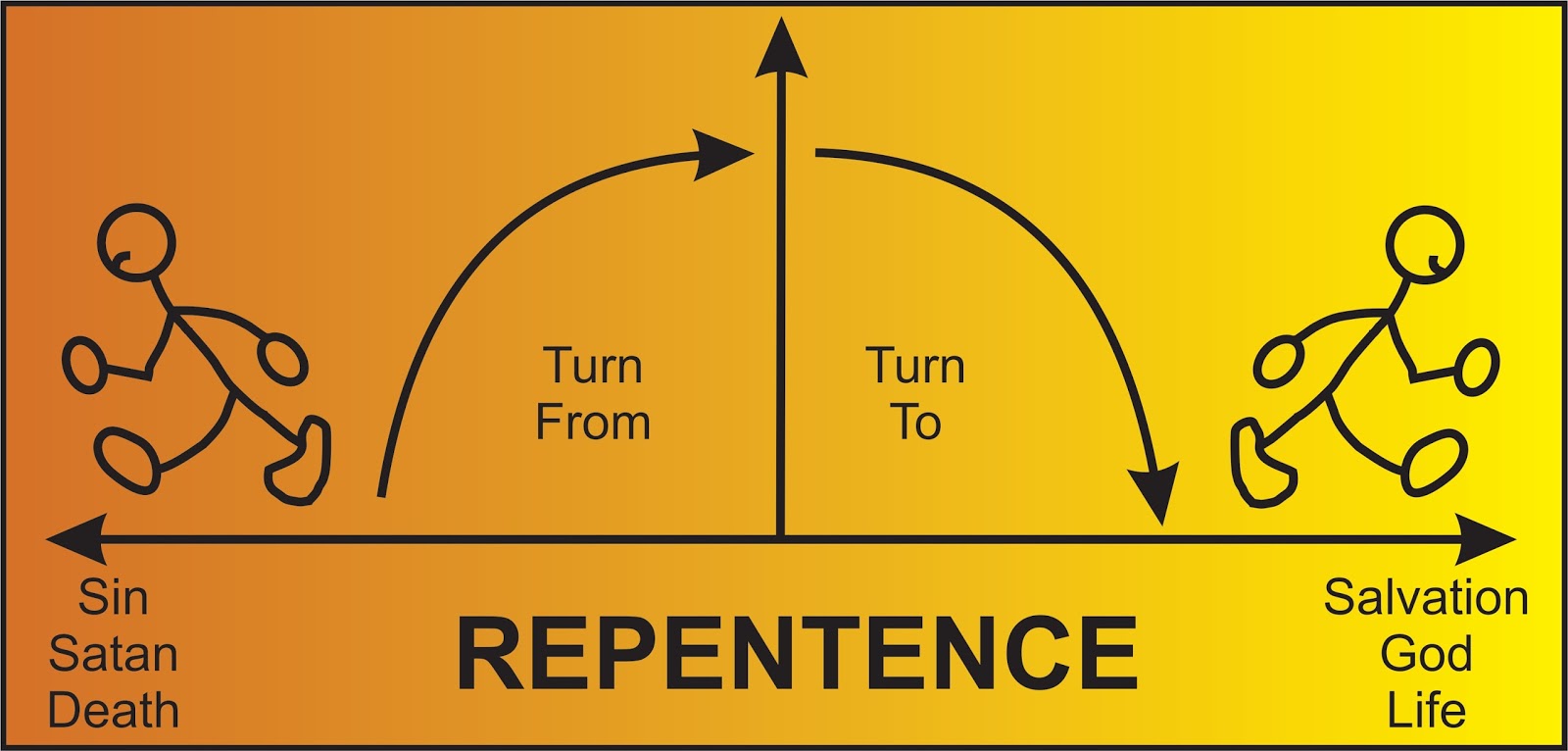
The first aspect of a genuine conversion experience is to comprehend who we are before God and what we have done that deserves God’s condemnation of our souls.  There are three parables in Luke chapter fifteen detailing the importance of repentance to God.  The parables are taught as a response to the questioning of the “Pharisees and scribes” (Luke 15:2) of why Christ “receiveth sinners.”  We need only read Matthew chapter twenty-three to find out Christ’s evaluation of the scribes and Pharisees as self-righteous hypocrites.  Therefore, it is easy to see that the purpose of these three parables in Luke chapter fifteen is to deal with the inability of the self-righteous moralist to see himself as a sinner before God and to see himself just as condemned as the worst of sinners.

“11And he said, A certain man had two sons: 12 And the younger of them said to his father, Father, give me the portion of goods that falleth to me. And he divided unto them his living. 13 And not many days after the younger son gathered all together, and took his journey into a far country, and there wasted his substance with riotous living. 14 And when he had spent all, there arose a mighty famine in that land; and he began to be in want. 15 And he went and joined himself to a citizen of that country; and he sent him into his fields to feed swine. 16 And he would fain have filled his belly with the husks that the swine did eat: and no man gave unto him. 17 And when he came to himself, he said, How many hired servants of my father’s have bread enough and to spare, and I perish with hunger! 18 I will arise and go to my father, and will say unto him, Father, I have sinned against heaven, and before thee, 19 And am no more worthy to be called thy son: make me as one of thy hired servants. 20 And he arose, and came to his father. But when he was yet a great way off, his father saw him, and had compassion, and ran, and fell on his neck, and kissed him. 21 And the son said unto him, Father, I have sinned against heaven, and in thy sight, and am no more worthy to be called thy son” (Luke 15:11-20).

The prodigal son’s change of mind resulted in a change of action that corresponded with his new evaluation of himself.  He no longer came to the father based upon what he deserved.  In repentance, he came to the father solely on the basis of grace and making an appeal to his grace.  The father responds in grace.  The picture before us is one of genuine salvation.
         
We are told in Luke 15:17 that the prodigal son “came to himself.”  This is critically essential in a genuine conversion experience.  Often people rescue those in the midst of the consequences of their sins before those people come to see their sins as the cause of their life disasters.  Cognizance of sin is the recognition that sin has temporal and eternal consequences connected to these actions.  Such cognizance of our sins brings the sinner to make a biblical evaluation of his character that has brought him to the situation in which he now exists.  It is not enough to want to merely escape the situation caused by his depravity.  Genuine repentance wants to escape the depravity that caused the situation.  If we miss this point, we fail to understand genuine repentance.  Such a person will soon be back drinking from that same old corrupting fountain.
         
This is why it is so difficult for the self-righteous religionists to come to repentance.  The self-righteous religionist views himself as a morally good person.  Jesus dealt with this failure in the mindset of the Jews often.  In Matthew chapter nineteen, Jesus has a conversation with a very rich “young man.”  The “young man” comes to Jesus and acknowledges Jesus as a “master,” or a teaching rabbi, that has understanding of the will of God.  His question is found in Matthew 19:16, “what good thing shall I do, that I may have eternal life?”  At first, Jesus bypasses his question and addresses the root of his problem.  The “young man” addressed Jesus as “Good {agathos} Master.”  Herein lies the first necessity in genuine repentance.  Jesus responds to the young man’s statement with a remarkable truth that confronted the very heart and soul of the misconceptions of thinking in the self-righteous religionists to coming to repentance.  Jesus says, “Why callest thou me good? there is none good but one, that is, God” (Matthew 19:17).  Only God is morally good all the time and all the time is the singular qualification for being self-righteous.  Only God is self-righteous.  Everyone else is a sinner because no one else but God is good all the time.
        
Jesus then exemplifies what moral goodness does in Matthew 19:21; “If thou wilt be perfect {teleios; morally complete}, go and sell that thou hast, and give to the poor, and thou shalt have treasure in heaven: and come and follow me.”  This exemplifies God’s moral perfection in God’s grace.  The “poor” were viewed by the self-righteous Jews as being sinners living in the consequences of their sin.  In other words, the Pharisees believed people were poor because they lived in sin, broke the Law, and were under God’s chastisement.  This was due to a misunderstanding of the “blessing and a curse” promise of God to the nation of Israel in the Mosaic Covenant.  The Jews applied the “blessing and a curse” promise of God to individuals.

“26 Behold, I set before you {plural, refers to all of the nation of Israel} this day a blessing and a curse; 27 A blessing, if ye obey the commandments of the LORD your God, which I command you this day: 28 And a curse {removal or withdrawal of blessings}, if ye will not obey the commandments of the LORD your God, but turn aside out of the way which I command you this day, to go after other gods, which ye have not known. 29 And it shall come to pass, when the LORD thy God hath brought thee in unto the land whither thou goest to possess it, that thou shalt put the blessing upon mount Gerizim, and the curse upon mount Ebal. 30 Are they not on the other side Jordan, by the way where the sun goeth down, in the land of the Canaanites, which dwell in the champaign {the sterile vally of Jordan} over against Gilgal, beside the plains of Moreh? 31 For ye shall pass over Jordan to go in to possess the land which the LORD your God giveth you, and ye shall possess it, and dwell therein. 32 And ye shall observe to do all the statutes and judgments which I set before you this day” (Deuteronomy 11:26-32). 

Therefore, when Jesus told the young man to sacrifice all of his earthly treasures to acquire the heavenly treasure of eternal life, the young man started to choke to death on his self-righteousness.  Christ Jesus was telling him that a change of mind about his wealth would result in using that wealth to exemplify God’s loving grace to the undeserving sinner.  This required more than just a change of thinking, but rather a change of mind that was accompanied by actually giving his wealth to benefit the poor.  Of course, doing so would bring him into poverty and total dependence upon God for his own sustenance.  This would require that he see himself in the degradation of his own spiritual poverty before God even in his temporal wealth.  This is why Jesus said to the disciples in the next few verses of Matthew 19:23 and 24, “Verily I say unto you, That a rich man shall hardly {duskolos; with great or extreme difficulty} enter into the kingdom of heaven. And again I say unto you, It is easier for a camel to go through the eye of a needle, than for a rich man to enter into the kingdom of God {get saved}.”

Jesus was exemplifying how this false notion of self-righteousness, and the false interpretation of wealth as a blessing upon self-righteousness, would keep the Moralist from seeing his true sinfulness before God and repent of the sin of self-righteousness.  The first point of genuine repentance is to understand “there is none good but one, that is, God” (Matthew 19:17).

Certainly we can see this repentance in the life of the Apostle Paul.  Paul reflects a completely different opinion of himself after he is “born again.”  Paul calls himself the chief “sinner” in I Timothy 1:15.  Paul stated his previous perverted opinion of himself and his false understanding of the Law in Philippians 3:4-6.

“4 Though I might also have confidence in the flesh. If any other man thinketh that he hath whereof he might trust in the flesh, I more: 5 Circumcised the eighth day, of the stock of Israel, of the tribe of Benjamin, an Hebrew of the Hebrews; as touching the law, a Pharisee; 6 Concerning zeal, persecuting the church; touching the righteousness which is in the law, blameless” (Philippians 3:4-6).

Paul’s statement in Philippians 3:4-8 reflects the dark blindness of self-righteousness of just how far short even these (man-kind righteousness) come from the glory of God (Romans 3:23; God-kind righteousness).  After salvation, Paul makes a statement regarding all truly repentant believers in their evaluation of themselves before God; “For we are the {true spiritual} circumcision, which worship God in the spirit, and rejoice in Christ Jesus, and have no confidence in the flesh” (Philippians 3:3). 

Self-righteousness is incapable of sanctifying anyone before God.  Self-righteousness will bring nothing but God’s loathing condemnation.  Paul understood this because this was the substance of his very first conversation with the resurrected and glorified Lord Jesus on the Damascus road when he got saved.  Paul rehearsed his conversion as he spoke to King Agrippa in Acts chapter twenty-six.  After which Paul was committed to the same message and the same repentance that brought about his own conversion.

“12 Whereupon as I went to Damascus with authority and commission from the chief priests, 13 At midday, O king, I saw in the way a light from heaven, above the brightness of the sun, shining round about me and them which journeyed with me. 14 And when we were all fallen to the earth, I heard a voice speaking unto me, and saying in the Hebrew tongue, Saul, Saul, why persecutest thou me? it is hard for thee to kick against the pricks. 15 And I said, Who art thou, Lord? And he said, I am Jesus whom thou persecutest. 16 But rise, and stand upon thy feet: for I have appeared unto thee for this purpose, to make thee a minister and a witness both of these things which thou hast seen, and of those things in the which I will appear unto thee; 17 Delivering thee from the people, and from the Gentiles, unto whom now I send thee, 18 To open their eyes, and to turn them from darkness to light, and from the power of Satan unto God, that they may {condition upon their turning; not just a change of mind} receive forgiveness of sins, and inheritance among them which are sanctified by faith that is in me. 19 Whereupon, O king Agrippa, I was not disobedient unto the heavenly vision: 20 But shewed first unto them of Damascus, and at Jerusalem, and throughout all the coasts of Judaea, and then to the Gentiles, that they should repent and turn to God, and do works meet for {comparable to; or living which aligns with their} repentance (Acts 26:12-20).

Certainly, the text reveals that genuine repentance is always expected to reflect a genuine change of life, not just a change of mind.  Genuine repentance involves turning “from darkness to light and from the power of Satan unto God” (Acts 26:18), not just a change of mind.  Action is involved in genuine repentance.  In other words, a change in direction is the outcome of genuine repentance.

We also know that this repentance text is not referring to merely turning away from trust in the “works of the Law” (Moralism and ritualism Sacerdotalism) because the text is referring to the Gentiles (Acts 26:20).  The Gentiles were not trusting in the “works of the Law” for their standing before God.  The Gentiles needed to repent of idolatry and the licentious, fornicating lifestyles that accompanied idolatry.

The word fornication often simply meant the practices of idolatry.  The Greek word translated “fornication” in the New Testament books is the word porneia (por-ni’-ah).  The word often simply means to practice the licentious, lustful sexual perversions of idolatry.  Turning completely away from this lifestyle and its practices was included in Gentile repentance.  These practices had become common in Israel prior to the Babylonian captivity.  God’s chastisement of the nation of Israel in the Babylonian captivity was intended to bring them to repentance and return them to pure worship of Jehovah and obedience to Him.  This is the biblical context of repentance of sin.  Repentance is a turning “from darkness to light, and from the power of Satan unto God” (Acts 26:18).  The Greek word translated “turn” in Acts 26:18 is epistrepho (ep-ee-stref’-o).  This same Greek word is often translated “converted” as it is in Acts 3:19.

In Acts 3:19, the subject of repentance to conversion is about the Person and redemptive work Jesus Christ in His death, burial, and resurrection/glorification.  This text addresses the Jews and their rejection of the Person and work of their promised Messiah. 

“12 And when Peter saw it {the wonder at the healing of the man lame from birth}, he answered unto the people, Ye men of Israel, why marvel ye at this? or why look ye so earnestly on us, as though by our own power or holiness we had made this man to walk? 13 The God of Abraham, and of Isaac, and of Jacob, the God of our fathers, hath glorified his Son Jesus; whom ye delivered up, and denied him in the presence of Pilate, when he was determined to let him go. 14 But ye {plural} denied the Holy One and the Just, and desired a murderer to be granted unto you; 15 And killed the Prince of life, whom God hath raised from the dead; whereof we are witnesses. 16 And his name through faith in his name hath made this man strong, whom ye see and know: yea, the faith which is by him hath given him this perfect soundness in the presence of you all. 17 And now, brethren, I wot that through ignorance ye did it, as did also your rulers. 18 But those things, which God before had shewed by the mouth of all his prophets, that Christ should suffer, he hath so fulfilled. 19 Repent {metanoeo} ye therefore, and be converted {epistrepho}, that your sins may be blotted out, when the times of refreshing {recovery of breath; the implication is spiritually revived from death} shall come from the presence of the Lord; 20 And he shall send Jesus Christ {the second coming}, which before was preached unto you: 21 Whom the heaven must receive until the times of restitution {the spiritual reconstruction of national Israel and the restoration of dominion to humanity through the last Adam, which is Christ Jesus} of all things, which God hath spoken by the mouth of all his holy prophets since the world began {Genesis 3:15}. 22 For Moses truly said unto the fathers {Deuteronomy 18:18}, A prophet shall the Lord your God raise up unto you of your brethren, like unto me; him shall ye hear in all things whatsoever he shall say unto you. 23 And it shall come to pass, that every soul, which will not hear that prophet, shall be destroyed from among the people. 24 Yea, and all the prophets from Samuel and those that follow after, as many as have spoken, have likewise foretold of these days. 25 Ye are the children of the prophets, and of the covenant which God made with our fathers, saying unto Abraham, And in thy seed shall all the kindreds of the earth be blessed. 26 Unto you first God, having raised up his Son Jesus, sent him to bless you, in turning away {apostrepho; to turn away or turn around} every one of you from his iniquities” (Acts 3:12-26).

Again, the pattern in Scripture is that biblical repentance always results in turning away from sin.  Biblical repentance is not merely a change of mind, but also a change of direction.  If a person’s life has no change of direction, repentance is not genuine and conversion has not taken place.

Anonymous comments will not be allowed. Numerous studies and series are available free of charge for local churches at: http://www.disciplemakerministries.org/ Dr. Lance Ketchum serves the Lord as a Church Planter, Evangelist/Revivalist. He has served the Lord for over 40 years.