
Expositional commentary on Scripture using an inductive exegetical methodology intent upon confronting the lives of Christians with the dogmatic Truths of God's inspired Words opposing Calvinism and Arminianism, Biblical commentary, doctrine of grace enablement, understanding holiness and wisdom and selfishness, in-depth Bible studies, adult Bible Study books and Sunday School materials Dr. Lance T. Ketchum Line Upon Line

Monday, November 16, 2015

Biblical Examples of Repentance in Conversion


Audio Link


Biblical Examples of Repentance in Conversion
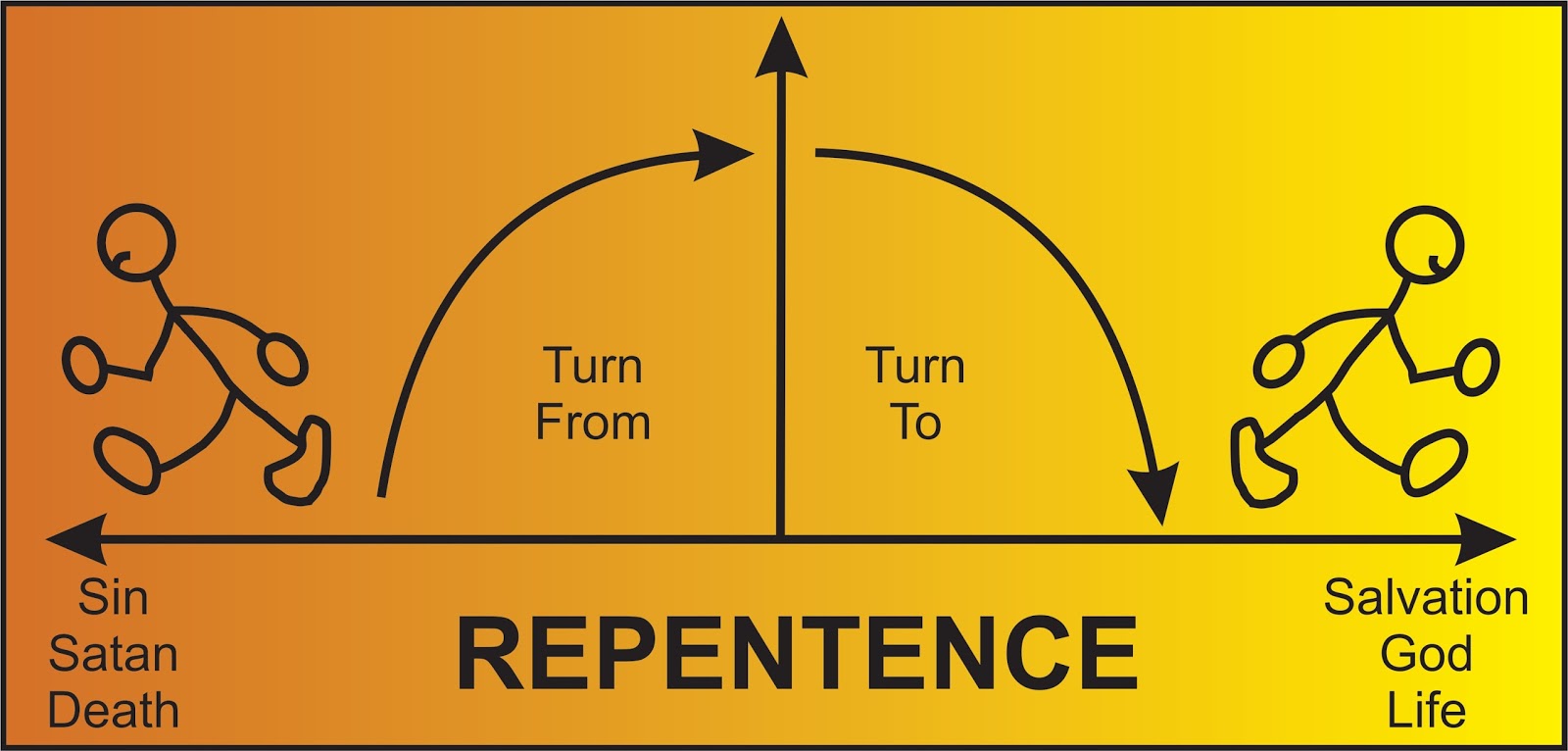
The first aspect of a genuine conversion experience is to comprehend who we are before God and what we have done that deserves God’s condemnation of our souls.  There are three parables in Luke chapter fifteen detailing the importance of repentance to God.  The parables are taught as a response to the questioning of the “Pharisees and scribes” (Luke 15:2) of why Christ “receiveth sinners.”  We need only read Matthew chapter twenty-three to find out Christ’s evaluation of the scribes and Pharisees as self-righteous hypocrites.  Therefore, it is easy to see that the purpose of these three parables in Luke chapter fifteen is to deal with the inability of the self-righteous moralist to see himself as a sinner before God and to see himself just as condemned as the worst of sinners.

“11And he said, A certain man had two sons: 12 And the younger of them said to his father, Father, give me the portion of goods that falleth to me. And he divided unto them his living. 13 And not many days after the younger son gathered all together, and took his journey into a far country, and there wasted his substance with riotous living. 14 And when he had spent all, there arose a mighty famine in that land; and he began to be in want. 15 And he went and joined himself to a citizen of that country; and he sent him into his fields to feed swine. 16 And he would fain have filled his belly with the husks that the swine did eat: and no man gave unto him. 17 And when he came to himself, he said, How many hired servants of my father’s have bread enough and to spare, and I perish with hunger! 18 I will arise and go to my father, and will say unto him, Father, I have sinned against heaven, and before thee, 19 And am no more worthy to be called thy son: make me as one of thy hired servants. 20 And he arose, and came to his father. But when he was yet a great way off, his father saw him, and had compassion, and ran, and fell on his neck, and kissed him. 21 And the son said unto him, Father, I have sinned against heaven, and in thy sight, and am no more worthy to be called thy son” (Luke 15:11-20).

The prodigal son’s change of mind resulted in a change of action that corresponded with his new evaluation of himself.  He no longer came to the father based upon what he deserved.  In repentance, he came to the father solely on the basis of grace and making an appeal to his grace.  The father responds in grace.  The picture before us is one of genuine salvation.
         
We are told in Luke 15:17 that the prodigal son “came to himself.”  This is critically essential in a genuine conversion experience.  Often people rescue those in the midst of the consequences of their sins before those people come to see their sins as the cause of their life disasters.  Cognizance of sin is the recognition that sin has temporal and eternal consequences connected to these actions.  Such cognizance of our sins brings the sinner to make a biblical evaluation of his character that has brought him to the situation in which he now exists.  It is not enough to want to merely escape the situation caused by his depravity.  Genuine repentance wants to escape the depravity that caused the situation.  If we miss this point, we fail to understand genuine repentance.  Such a person will soon be back drinking from that same old corrupting fountain.
         
This is why it is so difficult for the self-righteous religionists to come to repentance.  The self-righteous religionist views himself as a morally good person.  Jesus dealt with this failure in the mindset of the Jews often.  In Matthew chapter nineteen, Jesus has a conversation with a very rich “young man.”  The “young man” comes to Jesus and acknowledges Jesus as a “master,” or a teaching rabbi, that has understanding of the will of God.  His question is found in Matthew 19:16, “what good thing shall I do, that I may have eternal life?”  At first, Jesus bypasses his question and addresses the root of his problem.  The “young man” addressed Jesus as “Good {agathos} Master.”  Herein lies the first necessity in genuine repentance.  Jesus responds to the young man’s statement with a remarkable truth that confronted the very heart and soul of the misconceptions of thinking in the self-righteous religionists to coming to repentance.  Jesus says, “Why callest thou me good? there is none good but one, that is, God” (Matthew 19:17).  Only God is morally good all the time and all the time is the singular qualification for being self-righteous.  Only God is self-righteous.  Everyone else is a sinner because no one else but God is good all the time.
        
Jesus then exemplifies what moral goodness does in Matthew 19:21; “If thou wilt be perfect {teleios; morally complete}, go and sell that thou hast, and give to the poor, and thou shalt have treasure in heaven: and come and follow me.”  This exemplifies God’s moral perfection in God’s grace.  The “poor” were viewed by the self-righteous Jews as being sinners living in the consequences of their sin.  In other words, the Pharisees believed people were poor because they lived in sin, broke the Law, and were under God’s chastisement.  This was due to a misunderstanding of the “blessing and a curse” promise of God to the nation of Israel in the Mosaic Covenant.  The Jews applied the “blessing and a curse” promise of God to individuals.

“26 Behold, I set before you {plural, refers to all of the nation of Israel} this day a blessing and a curse; 27 A blessing, if ye obey the commandments of the LORD your God, which I command you this day: 28 And a curse {removal or withdrawal of blessings}, if ye will not obey the commandments of the LORD your God, but turn aside out of the way which I command you this day, to go after other gods, which ye have not known. 29 And it shall come to pass, when the LORD thy God hath brought thee in unto the land whither thou goest to possess it, that thou shalt put the blessing upon mount Gerizim, and the curse upon mount Ebal. 30 Are they not on the other side Jordan, by the way where the sun goeth down, in the land of the Canaanites, which dwell in the champaign {the sterile vally of Jordan} over against Gilgal, beside the plains of Moreh? 31 For ye shall pass over Jordan to go in to possess the land which the LORD your God giveth you, and ye shall possess it, and dwell therein. 32 And ye shall observe to do all the statutes and judgments which I set before you this day” (Deuteronomy 11:26-32). 

Therefore, when Jesus told the young man to sacrifice all of his earthly treasures to acquire the heavenly treasure of eternal life, the young man started to choke to death on his self-righteousness.  Christ Jesus was telling him that a change of mind about his wealth would result in using that wealth to exemplify God’s loving grace to the undeserving sinner.  This required more than just a change of thinking, but rather a change of mind that was accompanied by actually giving his wealth to benefit the poor.  Of course, doing so would bring him into poverty and total dependence upon God for his own sustenance.  This would require that he see himself in the degradation of his own spiritual poverty before God even in his temporal wealth.  This is why Jesus said to the disciples in the next few verses of Matthew 19:23 and 24, “Verily I say unto you, That a rich man shall hardly {duskolos; with great or extreme difficulty} enter into the kingdom of heaven. And again I say unto you, It is easier for a camel to go through the eye of a needle, than for a rich man to enter into the kingdom of God {get saved}.”

Jesus was exemplifying how this false notion of self-righteousness, and the false interpretation of wealth as a blessing upon self-righteousness, would keep the Moralist from seeing his true sinfulness before God and repent of the sin of self-righteousness.  The first point of genuine repentance is to understand “there is none good but one, that is, God” (Matthew 19:17).

Certainly we can see this repentance in the life of the Apostle Paul.  Paul reflects a completely different opinion of himself after he is “born again.”  Paul calls himself the chief “sinner” in I Timothy 1:15.  Paul stated his previous perverted opinion of himself and his false understanding of the Law in Philippians 3:4-6.

“4 Though I might also have confidence in the flesh. If any other man thinketh that he hath whereof he might trust in the flesh, I more: 5 Circumcised the eighth day, of the stock of Israel, of the tribe of Benjamin, an Hebrew of the Hebrews; as touching the law, a Pharisee; 6 Concerning zeal, persecuting the church; touching the righteousness which is in the law, blameless” (Philippians 3:4-6).

Paul’s statement in Philippians 3:4-8 reflects the dark blindness of self-righteousness of just how far short even these (man-kind righteousness) come from the glory of God (Romans 3:23; God-kind righteousness).  After salvation, Paul makes a statement regarding all truly repentant believers in their evaluation of themselves before God; “For we are the {true spiritual} circumcision, which worship God in the spirit, and rejoice in Christ Jesus, and have no confidence in the flesh” (Philippians 3:3). 

Self-righteousness is incapable of sanctifying anyone before God.  Self-righteousness will bring nothing but God’s loathing condemnation.  Paul understood this because this was the substance of his very first conversation with the resurrected and glorified Lord Jesus on the Damascus road when he got saved.  Paul rehearsed his conversion as he spoke to King Agrippa in Acts chapter twenty-six.  After which Paul was committed to the same message and the same repentance that brought about his own conversion.

“12 Whereupon as I went to Damascus with authority and commission from the chief priests, 13 At midday, O king, I saw in the way a light from heaven, above the brightness of the sun, shining round about me and them which journeyed with me. 14 And when we were all fallen to the earth, I heard a voice speaking unto me, and saying in the Hebrew tongue, Saul, Saul, why persecutest thou me? it is hard for thee to kick against the pricks. 15 And I said, Who art thou, Lord? And he said, I am Jesus whom thou persecutest. 16 But rise, and stand upon thy feet: for I have appeared unto thee for this purpose, to make thee a minister and a witness both of these things which thou hast seen, and of those things in the which I will appear unto thee; 17 Delivering thee from the people, and from the Gentiles, unto whom now I send thee, 18 To open their eyes, and to turn them from darkness to light, and from the power of Satan unto God, that they may {condition upon their turning; not just a change of mind} receive forgiveness of sins, and inheritance among them which are sanctified by faith that is in me. 19 Whereupon, O king Agrippa, I was not disobedient unto the heavenly vision: 20 But shewed first unto them of Damascus, and at Jerusalem, and throughout all the coasts of Judaea, and then to the Gentiles, that they should repent and turn to God, and do works meet for {comparable to; or living which aligns with their} repentance (Acts 26:12-20).

Certainly, the text reveals that genuine repentance is always expected to reflect a genuine change of life, not just a change of mind.  Genuine repentance involves turning “from darkness to light and from the power of Satan unto God” (Acts 26:18), not just a change of mind.  Action is involved in genuine repentance.  In other words, a change in direction is the outcome of genuine repentance.

We also know that this repentance text is not referring to merely turning away from trust in the “works of the Law” (Moralism and ritualism Sacerdotalism) because the text is referring to the Gentiles (Acts 26:20).  The Gentiles were not trusting in the “works of the Law” for their standing before God.  The Gentiles needed to repent of idolatry and the licentious, fornicating lifestyles that accompanied idolatry.

The word fornication often simply meant the practices of idolatry.  The Greek word translated “fornication” in the New Testament books is the word porneia (por-ni’-ah).  The word often simply means to practice the licentious, lustful sexual perversions of idolatry.  Turning completely away from this lifestyle and its practices was included in Gentile repentance.  These practices had become common in Israel prior to the Babylonian captivity.  God’s chastisement of the nation of Israel in the Babylonian captivity was intended to bring them to repentance and return them to pure worship of Jehovah and obedience to Him.  This is the biblical context of repentance of sin.  Repentance is a turning “from darkness to light, and from the power of Satan unto God” (Acts 26:18).  The Greek word translated “turn” in Acts 26:18 is epistrepho (ep-ee-stref’-o).  This same Greek word is often translated “converted” as it is in Acts 3:19.

In Acts 3:19, the subject of repentance to conversion is about the Person and redemptive work Jesus Christ in His death, burial, and resurrection/glorification.  This text addresses the Jews and their rejection of the Person and work of their promised Messiah. 

“12 And when Peter saw it {the wonder at the healing of the man lame from birth}, he answered unto the people, Ye men of Israel, why marvel ye at this? or why look ye so earnestly on us, as though by our own power or holiness we had made this man to walk? 13 The God of Abraham, and of Isaac, and of Jacob, the God of our fathers, hath glorified his Son Jesus; whom ye delivered up, and denied him in the presence of Pilate, when he was determined to let him go. 14 But ye {plural} denied the Holy One and the Just, and desired a murderer to be granted unto you; 15 And killed the Prince of life, whom God hath raised from the dead; whereof we are witnesses. 16 And his name through faith in his name hath made this man strong, whom ye see and know: yea, the faith which is by him hath given him this perfect soundness in the presence of you all. 17 And now, brethren, I wot that through ignorance ye did it, as did also your rulers. 18 But those things, which God before had shewed by the mouth of all his prophets, that Christ should suffer, he hath so fulfilled. 19 Repent {metanoeo} ye therefore, and be converted {epistrepho}, that your sins may be blotted out, when the times of refreshing {recovery of breath; the implication is spiritually revived from death} shall come from the presence of the Lord; 20 And he shall send Jesus Christ {the second coming}, which before was preached unto you: 21 Whom the heaven must receive until the times of restitution {the spiritual reconstruction of national Israel and the restoration of dominion to humanity through the last Adam, which is Christ Jesus} of all things, which God hath spoken by the mouth of all his holy prophets since the world began {Genesis 3:15}. 22 For Moses truly said unto the fathers {Deuteronomy 18:18}, A prophet shall the Lord your God raise up unto you of your brethren, like unto me; him shall ye hear in all things whatsoever he shall say unto you. 23 And it shall come to pass, that every soul, which will not hear that prophet, shall be destroyed from among the people. 24 Yea, and all the prophets from Samuel and those that follow after, as many as have spoken, have likewise foretold of these days. 25 Ye are the children of the prophets, and of the covenant which God made with our fathers, saying unto Abraham, And in thy seed shall all the kindreds of the earth be blessed. 26 Unto you first God, having raised up his Son Jesus, sent him to bless you, in turning away {apostrepho; to turn away or turn around} every one of you from his iniquities” (Acts 3:12-26).

Again, the pattern in Scripture is that biblical repentance always results in turning away from sin.  Biblical repentance is not merely a change of mind, but also a change of direction.  If a person’s life has no change of direction, repentance is not genuine and conversion has not taken place.

Anonymous comments will not be allowed. Numerous studies and series are available free of charge for local churches at: http://www.disciplemakerministries.org/ Dr. Lance Ketchum serves the Lord as a Church Planter, Evangelist/Revivalist. He has served the Lord for over 40 years.

Monday, November 9, 2015

Woe to the Idol Makers


Woe to the Idol Makers


Satan is the ultimate corrupter.  He first seeks to corrupt the Word of God.  He wrests and twists biblical principles where in turn he corrupts the knowledge of God.  He causes people to question the authenticity and veracity of the Word of God.  Then, he seeks to corrupt the worship of God by incorporating worldliness into that worship.  His ultimate source of corruption is when he joins a local church in the form of corrupted professors of Christ.  

In paganism, this corruption and enticement took the form of numerous sexual perversions incorporated into the worship of pagan idols.  When Israel was delivered from Egyptian bondage, the mixed multitude that came with them to Mt. Sinai easily convinced the Jews to worship Jehovah in the form of a golden calf and with sexual licentious practices (nudity and dancing).  God has always hated these corruptions.  He speaks in a general condemnation to the foolishness of false worship practices and idolatry in Habakkuk 2:18-20.

18 What profiteth the graven image that the maker thereof hath graven it; the molten image, and a teacher of lies, that the maker of his work trusteth therein, to make dumb idols? 19 Woe unto him that saith to the wood, Awake; to the dumb stone, Arise, it shall teach! Behold, it is laid over with gold and silver, and there is no breath at all in the midst of it. 20 But the LORD is in his holy temple: let all the earth keep silence before him” (Habakkuk 2:18-20).

          In these last three verses of Habakkuk chapter two, we have the fifth “woe” pronounced upon five different lifestyles.  This “woe” comes upon the idolatrous lifestyle of false worship.  Any form of false worship, or false worship practice, is idolatry.  Idolatry comes in many forms and with many names.  Idolatry is the worship of anything or anyone other than the God of the Bible.  This includes any form of worship or exaltation of something or someone other than God.  All bases are covered in the first commandment.  “Thou shalt have no other gods before me” (Exodus 20:3).  The intent here is that nothing or no one was to be worshiped other than the one true God of the Bible.
          Secondly, God must be worshiped in a specific way.  When Jesus spoke to the women at the well in John chapter four, He spoke against the perverted worship practices of the Samaritans and gave specific instruction about the only acceptable way in which the true God could be worshiped.  The methods and means we use to worship God must be distinct from the world. 

19 The woman saith unto him, Sir, I perceive that thou art a prophet. 20 Our fathers worshipped in this mountain; and ye say, that in Jerusalem is the place where men ought to worship. 21 Jesus saith unto her, Woman, believe me, the hour cometh, when ye shall neither in this mountain, nor yet at Jerusalem, worship the Father. 22 Ye worship ye know not what: we know what we worship: for salvation is of the Jews. 23 But the hour cometh, and now is, when the true worshippers shall worship the Father in spirit and in truth: for the Father seeketh such to worship him. 24 God is a Spirit: and they that worship him must worship him in spirit and in truth” (John 4:19-24).

          Jesus told the Samaritan women “Ye worship ye know not what” (John 4:22).  Understand the context of the discussion recorded in John 4:19-22.  This was a woman with a reputation that was contrary to the Law of God that she professed to believe even as a Samaritan; 17b Thou hast well said, I have no husband: 18 For thou hast had five husbands; and he whom thou now hast is not thy husband: in that saidst thou truly” (John 4:17b-18).  The Samaritans believed in the five books of the Law and in the same God that the Jews believed in.  However, they did not read the prophets or the Psalms and Proverbs.  Therefore, they had a very shallow and superficial theology. 
          The fact that this woman was a publicly known adulteress, and was still living, revealed that the Samaritans did not enforce the Law they professed to believe.  In other words, they had corrupted justice, condoned moral turpitude, and had abandoned the sacrosanctity that was to be established by the Law of God in the Pentateuch.  Therefore, their knowledge of God was corrupted and, although they called God by His Bible Names, they did not really worship or know the God of the Bible.  Before they could worship properly and in sacrosanctity, their knowledge of God (Theology) had to be corrected. 
True worship is only acceptable when it is offered though a sanctified life.  A sanctified life is not necessary a sinless life, but rather a life that is cognizant of sin, repentant and remorseful about sin, and is accompanied by a genuine heart motivation to live for God.  The whole of the Levitical Law was to establish the necessities of sacrifice to maintain a sanctified heart before God.  The sacrifices were completely empty in the eyes of God if they were not preceded by cognizance of sin, repentance and remorse about sin, and accompanied by a genuine heart motivation to live for God.  God spoke to this problem of worship without sanctity of the heart in Isaiah chapter twenty-nine.  God says that Israel had gotten the sacrifices “upside down.”  In other words, the issues of the heart MUST precede the offering of sacrifices.  Outside of the sanctity of the heart before God, all worship forms are reduced to mere idolatry. 

13 Wherefore the Lord said, Forasmuch as this people draw near me with their mouth, and with their lips do honour me, but have removed their heart far from me, and their fear {moral reverence in that they are sinners before a holy God} toward me is taught by the precept of men {just talk}: 14 Therefore, behold, I will proceed to do a marvellous work among this people, even a marvellous work and a wonder: for the wisdom of their wise men shall perish, and the understanding of their prudent men shall be hid. 15 Woe unto them that seek deep to hide their counsel from the LORD, and their works are in the dark, and they say, Who seeth us? and who knoweth us? 16 Surely your turning of things upside down shall be esteemed as the potter’s clay: for shall the work say of him that made it, He made me not? or shall the thing framed say of him that framed it, He had no understanding” (Isaiah 29:13-16)?

          Perhaps the greatest form of false worship is that worship that lacks moral reverence (awe and fear) because people are not cognizant of the sinfulness of their sin, nor are they cognizant of holiness of God.  This ignorance leads people into false worship practices in that the ignorance corrupts the character and nature of God.  A false god is created in the image of man while people ignorantly believe they are worshiping the true God.  Simply defined, idolatry is any form of distorted worship.  The Samaritans had perverted worship to such an extent that Jesus said they didn’t know what they worshiped, let alone who they worshiped (John 4:22).  They were idolaters in two senses of the word.

1. They worshiped God in the form of graven images.
2. They worshiped in an unapproved place.

In the Old Testament, formal sacerdotal worship was only accepted through the approved Levitical priesthood (sanctified and consecrated to God) and at the approved place signified by the presence of the Ark of the Covenant.  Prayer, reading of the Scriptures, and general adoration of God as forms of worship were acceptable to God at any time and from almost anywhere.  However, means and methods of worship contrary to holiness and the sacrosanctity of the heart were never acceptable to God at any time or anywhere.  There is abject foolishness in much of Convergent and Emergent Evangelicalism regarding what is acceptable forms in the means and methods of worshipping God.  For such people, it seems they govern themselves by one simple principle – ANYTHING GOES!
          In order to escape the pollution and defilement of idolatry, a believer must worship God spiritually because God is a Spirit.  He is not an idol and (other than the incarnation) He is not a man.  God is not to be worshiped with artificial semblances of superficial forms.  Any such forms cannot adequately represent God.  Therefore, by the very nature of that inadequacy, they will misrepresent God.  Thereby, they change “the glory of the uncorruptible God into an image made like to corruptible man, and to birds, and fourfooted beasts, and creeping things” (Romans 1:23).  When the character, nature, and/or attributes of God are corrupted and misrepresented in any way, God is de-glorified in that misrepresentation.  To the degree God is de-glorified, idolatry is created. 
          This is why we have no sculptures of Jesus, no portraits of Jesus, or even any drawings of Jesus.  God does not want Him to be worshiped because of the form He took, but for the substance of what He accomplished as the “last Adam” and the essence of His Person (communicable attributes), to which every believer is being conformed through progressive sanctification.  True worship, genuine worship, is born only from a genuine desire for this inward conformation to the image of Christ. 

19 For the earnest expectation of the creature waiteth for the manifestation of the sons of God. 20 For the creature {creation, the original formation} was made subject to vanity {uselessness}, not willingly, but by reason of him who hath subjected the same in hope, 21 Because the creature itself also shall be delivered from the bondage of corruption into the glorious liberty of the children of God. 22 For we know that the whole creation groaneth and travaileth in pain {to birth the New Genesis “in Christ”} together until now. 23 And not only they, but ourselves also, which have the firstfruits of the Spirit {into the New Creation}, even we ourselves groan within ourselves, waiting for the adoption, to wit, the redemption of our body” (Romans 6:19-23).

Secondly, before worship can escape the definition of idolatry, worship of God must be “in truth.”  In other words, a believer must worship God for Who and What God really is as defined by the Word of God.  This requires an accurate understanding of God’s revelation of Himself in the Scriptures.  As John 4:24 says, “God is spirit.”  In other words, God is not corporeal.  God is evident only as “light” referred to as “glory” in the Bible.  However, the “glory” of God is the manifestation of all of the attributes of God.  It is difficult for human beings to even comprehend a non-corporeal being like God, Who yet is omnipresent, omnipotent, and omniscient.  It is because humanity cannot comprehend God as a non-corporeal Being that they so quickly are prepared to give Him some artificial form with which they might identify. 
          The great problem that unbelieving people have with the God of the Bible is that He is incomprehensible to their intellect and intangible to their senses.  Therefore, the God of the Bible angers them because the very essence of His existence declares them ignorant in that the very nature of God is far beyond them.  The narcissistic worshipers of the human intellect cannot believe in a Being who cannot be comprehended by their superior intellects.  Therefore, they angrily shake their puny little fists in the face of the God they proclaim as non-existent as if that gesture somehow makes Him non-existent.  What fools!
          If there is any distortion of our understanding of Who and What God is, our worship will be misdirected to something other than the God of the Bible.  Instead, we will worship a distortion of Him and therefore not be worshiping Him at all.  Whatever the degree of the distortion of truth that defines God is the degree of our idolatry.  The degree of this distortion of truth is the degree the God that we worship becomes a man-made (manufactured) god.  Even though a person may use biblical names to describe the god he worships, his god may still be an idol if that god does not correspond accurately with the Bible’s description of God.  God cannot be worshiped in any corporeal form.  He MUST be worshiped as the Spirit that He is as defined by His revelation of Himself in the Word of God. 

The fifth “woe” of Habakkuk chapter two comes against both the makers of idols and the propagators of idolatry and those who ignorantly follow their leadership. 

Much of what professes to be Christian worship these day is nothing but modified idolatry.  The actual idols may be in pastor worship, music or musician worship, or social networking worship, but all such nonsense is still idolatrous in nature.  The point of such forms of idolatry is that these are reasons why people attend church services.  They may not even consider that the object of their attention and focus is supposed to be upon the adoration, worship, and praise of their Redeemer.  They are willing to listen to a self-help sermon to improve their lives.  They can sing songs or listen to performances of music that mention God.  They can look forward to seeing friends and to social interaction with those people.  They can do all of these things with little or no acknowledgment of the presence of or without having a personal relationship with God.  They can do all of these things without ever considering the sinfulness of their natures before God.  Neither are they cognizant that God is holy and awesome.  Therefore, they have no awe of God or genuine reverence for Him.  In either case, genuine worship is absent.  
The question that God addresses to the Israelites through the prophet Habakkuk is a simple one.  Has idol worship, and following those who propagate idol worship, ever gotten you anything except God’s wrath?  
Idolatry is defined as worshiping someone or something other than, or before, the true God of the Bible.  Even trying to represent God in some form is idolatry.  Idolatry can also be worshiping God with worldly methods or more specifically with non-sacred instrumentality.  Worshiping God in any form is unscriptural.  Worshiping God through worldly instrumentals is equally unscriptural. 
Contemporary worship propagators tell us that the mechanics of worship and the means we use to worship God are insignificant as long as the attitudes of our hearts are right about God.  This is foolishness.  We know this with certainty merely from God’s response in Exodus chapter thirty-two to those that sought to worship Jehovah in form of a golden calf and through the means of riotous music and dancing.  The pagans worshiped their gods in this manner.  God would have none of it!  There is no evidence in the text that their heart attitudes about God were wrong.  The people offered sacrifices and sought to worship Jehovah.  However, the mechanics (form) and means (riotous music and dancing) of their worship was unacceptable to God. 
We read of numerous other warnings in the Old Testament regarding the worship of idols and the abominable worship practices that went along with idolatry.  One prime example is II Kings 17:1-12.  This text defines the historical foundation for the corruption that became the Samaritans. 

1 In the twelfth year of Ahaz king of Judah began Hoshea the son of Elah to reign in Samaria over Israel nine years. 2 And he did that which was evil in the sight of the LORD, but not as the kings of Israel that were before him. 3 Against him came up Shalmaneser king of Assyria; and Hoshea became his servant, and gave him presents. 4 And the king of Assyria found conspiracy in Hoshea: for he had sent messengers to So king of Egypt, and brought no present to the king of Assyria, as he had done year by year: therefore the king of Assyria shut him up, and bound him in prison. 5 Then the king of Assyria came up throughout all the land, and went up to Samaria, and besieged it three years. 6 In the ninth year of Hoshea the king of Assyria took Samaria, and carried Israel away into Assyria, and placed them in Halah and in Habor by the river of Gozan, and in the cities of the Medes. 7 For so it was, that the children of Israel {the ten Northern tribes} had sinned against the LORD their God, which had brought them up out of the land of Egypt, from under the hand of Pharaoh king of Egypt, and had feared other gods, 8 And walked in the statutes of the heathen, whom the LORD cast out from before the children of Israel, and of the kings of Israel, which they had made. 9 And the children of Israel {the ten Northern tribes} did secretly those things that were not right against the LORD their God, and they built them high places in all their cities, from the tower of the watchmen to the fenced city. 10 And they set them up images and groves in every high hill, and under every green tree: 11 And there they burnt incense in all the high places, as did the heathen whom the LORD carried away before them; and wrought wicked things to provoke the LORD to anger: 12 For they served idols, whereof the LORD had said unto them, Ye shall not do this thing” (II Kings 17:1-12).

Centrally, each of the “woes” detailed in Habakkuk chapter two were an answer to Habakkuk’s question of how God can seemingly bless the Chaldeans by allowing them to overthrow the nation of Israel.  The “woes” are actually upon the Chaldeans and all nations like them.  Israel had become a nation like them.  The only thing that kept Israel from total destruction was the covenant promise of God to Abraham.  The “woes” come to us individually as a promise to those who refuse to become like the heathens in that God’s justice and righteousness is sovereign and will prevail.
Image makers give form to false gods.  The “teacher of lies” refers to the pagan priest who gave the idol a voice by becoming the idol’s voice.  The only way the dumb idol could teach was through the idolatrous priest.  The very nature of an idolatrous priest is one of deception (“lies”).  His income and well being is totally dependent upon how many people he can deceive into worshiping the idol.

The greatest folly of idolatry is to make up a god and then worship and pray to the god you just created.  What kind of idiot goes into the woods, cuts down a tree, carves it into the shape of some animal or person, overlays it with gold and precious stones, and then offers sacrifice too it?  What kind of idiot people chisel a statue out of stone or mold one out of metal, then build a fire in its outstretched arms and sacrifice their children to it?  The only idiots who would do such things are satanically deceived idiots.  
There must have been a great deal of satanic activity involved in all of this or there must have been some very deceptive and manipulative priests (“teacher of lies”).  Beware of people who claim to speak for God but do not believe in God’s Word or preach God’s Word.  There are many such preachers in the world in these last days; more than what we can imagine. 

11 And I beheld another beast {the false prophet} coming up out of the earth; and he had two horns like a lamb, and he spake as a dragon. 12 And he exerciseth all the power of the first beast {the Antichrist} before him, and causeth the earth and them which dwell therein to worship the first beast {the Antichrist}, whose deadly wound was healed. 13 And he doeth great wonders, so that he maketh fire come down from heaven on the earth in the sight of men, 14 And deceiveth them that dwell on the earth by the means of those miracles which he had power to do in the sight of the beast; saying to them that dwell on the earth, that they should make an image to the beast, which had the wound by a sword, and did live” (Revelation 13:11-14).

“Woe unto him” (Habakkuk 2:19) refers to the person deceived by idolatry and who is the “teacher of lies.”

There is no “woe” on the idol because the idol is nothing more than a piece of decorated wood; a piece of stone or metal.  The idol is nothing (I Corinthians 8:4). Satan’s deception does not come through the idol, but through the men who make the idols and teach the lies about them.  Idols are not judged or damned.  Idolaters are judged and damned.

4 As concerning therefore the eating of those things that are offered in sacrifice unto idols, we know that an idol is nothing in the world, and that there is none other God but one. 5 For though there be that are called gods, whether in heaven or in earth, (as there be gods many, and lords many,) 6 But to us there is but one God, the Father, of whom are all things, and we in him; and one Lord Jesus Christ, by whom are all things, and we by him” (I Corinthians 8:4-6).


To “behold,” regarding the made up god, means to take hold of it.  The Hebrew word is taphas (taw-fas’).  The challenge is to examine it carefully to see if there is any life or reality to the thing being called a god.  When the examination is finished, the conclusion will be that the thing is lifeless.  Common to the mystery religions were the practices of Ecstasism and Enthusiasm. S. Angus, in his book The Mystery Religions (New York: Dover Publications, 1975) details these two practices.  This is the same experience created by using C.C.M. in churches.

“...Ecstasy (ekstasis) and Enthusiasm (enthusiasmos), both of which might be induced by vigil and fasting, tense religious expectancy, whirling dances, physical stimuli, the contemplation of sacred objects, the effect of stirring music, inhalation of fumes, revivalistic contagion (such as happened in the church at Corinth), hallucination, suggestion, and other means belonging to the apparatus of the Mysteries.”

          Both Ecstasy and Enthusiasm were used to promote a heightened sense of euphoria and human experience.  In this euphoric state, the participant experiences a feeling of having communed with deity.  His involvement has been with the supernatural realm, but not the divine.  Both Ecstasism and Enthusiasm are Satanic in origin.
          “But” (Habakkuk 2:20), this is not so of the real God.  The evidence for the existence of the real God is overwhelming.  There is but one true God and He dwells in His Holy Temple.  God’s statements to backslidden Israel are redundant with affirmations of His singularity as the only one true God. 

Thus saith the LORD the King of Israel, and his redeemer the LORD of hosts; I am the first, and I am the last; and beside me there is no God (Isaiah 44:6).

Fear ye not, neither be afraid: have not I told thee from that time, and have declared it? ye are even my witnesses. Is there a God beside me? yea, there is no God; I know not any (Isaiah 44:8).

5 I am the LORD, and there is none else, there is no God beside me: I girded thee, though thou hast not known me: 6 That they may know from the rising of the sun, and from the west, that there is none beside me. I am the LORD, and there is none else (Isaiah 45:5-6).

Tell ye, and bring them near; yea, let them take counsel together: who hath declared this from ancient time? who hath told it from that time? have not I the LORD? and there is no God else beside me; a just God and a Saviour; there is none beside me (Isaiah 45:21).

Unlike a lifeless idol, God is transcendent; meaning He is above and beyond all His creation.  This means that God is separate from His creation, which is now fallen and corrupted.  God is not dependent upon this creation in anyway or for anything. 
We have a movement in professing Christianity that seeks to remake God in a contemporary way.  In doing so, they create a false god that is extemporaneous (obsolete).  God cannot be recreated to fit the whims and fancies of the Church Growth movement in order to placate the crowds of carnals that want a semblance of religion without any real knowledge of, or responsibilities to, the God they profess to worship. 

For thus saith the high and lofty One that inhabiteth eternity, whose name is Holy; I dwell in the high and holy place, with him also that is of a contrite and humble spirit, to revive the spirit of the humble, and to revive the heart of the contrite ones (Isaiah 57:15).

Even though God is transcendent, He is immanent, meaning He is present with us and wants fellowship with us.  This God wants personal contact with His children.  He wants us to talk to Him (prayer).  He wants to talk with us (preaching and reading His Word).  He wants intimacy with us in that He lives within us in the Person of His Holy Spirit.  He wants to fill our lives to overflowing with His communicable attributes to which He refers as the “fruit of the Spirit.”  Very few professing Christians ever realize the practical aspects of God’s immanency.  The fact of God’s immanency means there is no place, no thought, no emotion in our lives that escapes His attention. 

23 Am I a God at hand, saith the LORD, and not a God afar off? 24 Can any hide himself in secret places that I shall not see him? saith the LORD. Do not I fill heaven and earth? saith the LORD (Jeremiah 23:24).

7 Whither shall I go from thy spirit? or whither shall I flee from thy presence? 8 If I ascend up into heaven, thou art there: if I make my bed in hell, behold, thou art there. 9 If I take the wings of the morning, and dwell in the uttermost parts of the sea; 10 Even there shall thy hand lead me, and thy right hand shall hold me (Psalm 139:7-10).

A Bible knowledge of God should naturally generate a silent awe when we know we are in His presence.  “Let all the earth keep silence before Him” (Habakkuk 2:20).  If we know the holiness of God and how far short we come of His glory, we will stand trembling in silence before Him.  The intent of the words, “Let all the earth keep silence before Him” is that all men should stand in silent awe awaiting God’s judgment, for it is to be soon upon us!
          If the God of the Bible is real, He deserves our full devotion, absolute worship, and solemn fear.  God’s concluding statement in Habakkuk 2:20 should be the resolve of everyone who believes He is real.  What God says He will do, He will do! When you think of the God of the Bible, do you stand in hushed awe before His immanent presence?  God is both immanent (near) and eminent (soon appearing).  Do you realize this and live in this reality?  If you do not, perhaps you do not know the God of the Bible.


Anonymous comments will not be allowed. Numerous studies and series are available free of charge for local churches at: http://www.disciplemakerministries.org/ Dr. Lance Ketchum serves the Lord as a Church Planter, Evangelist/Revivalist. He has served the Lord for over 40 years.
